Band 5.0 IELTS Writing Task 1 Model Answer
Overall Band Score: 5.0 · Cambridge IELTS 11 · 2026-11-19
IELTS Writing Task 1 question
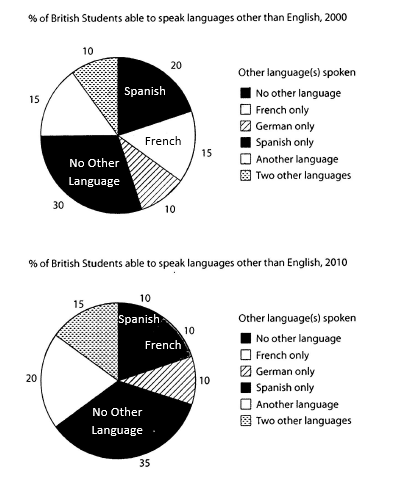
The charts below show the proportions of British students at one university in England who were able to speak other languages in addition to English, in 2000 and 2010
Summarise the information by selecting and reporting the main features, and make comparisons where relevant.
Student answer (Band 5.0)
The given bar chart elucidates information about percentage of british students able to speak languages other than English , 2000 . The chart compares the data in number or percentage . Overall it is clear that there are noticeable differences among the categories shown in the chart . According to the chart the French language is 15% the German language is 10% the spanish language is 20% the two other language is 10% and the last no other language is 30% . In additions some categories show some fluctuations by following increment as well as decrement whereas for some cases they remain stable . The second part is percentage of british student able to speak languages other than English ,2010 . The french language is 10% the spanish language is 10% the German language is 10% the two others language is 15% the no other language is 35% and the another language is 20 % . This show a clear comparison among the activites. Furthermore, all the provided data suggests that there is no stability in the all activites .
AI examiner evaluation
| Criterion | Band |
|---|---|
| Task Achievement / Task Response | 4.5 |
| Coherence and Cohesion | 5.0 |
| Lexical Resource | 5.5 |
| Grammatical Range and Accuracy | 5.0 |
| Overall | 5.0 |
Task Achievement / Task Response: Band 4.5
You report several figures accurately, including French at 15% and Spanish at 20% in 2000, and the 2010 figures for no other language (35%) and another language (20%). However, the response only minimally summarises the charts: it gives lists of values rather than identifying the main changes or comparing the two years. For example, Spanish fell from 20% to 10%, while the proportions speaking another language or two other languages rose; these important trends are not clearly reported. The overview is also vague: “noticeable differences” and “no stability” do not explain the main pattern, and the latter is inaccurate because German remained at 10%. Focus on the largest changes and state a precise overall comparison.
Coherence and Cohesion: Band 5.0
The response has a basic sequence, moving from 2000 figures to 2010 figures, and phrases such as “Overall” and “Furthermore” show an attempt to guide the reader. However, there is no clear paragraphing or developed progression from an overview to selected comparisons. The repeated list-like sentences make the two years feel separate rather than directly compared, and “In additions” and “This show a clear comparison” do not create clear links between ideas. The final statement that there is “no stability” also conflicts with the earlier figures without explaining why. Group the information into an overview and comparison paragraphs, and use linking language to show increases, decreases and unchanged values.
Lexical Resource: Band 5.5
You use some task-related vocabulary, including “percentage,” “categories,” “increment,” “decrement” and “stable,” so the reader can generally understand that the response concerns language proportions and changes. However, the range is limited and several expressions are imprecise or unnatural for describing charts, such as “the chart elucidates information,” “the data in number or percentage,” and “clear comparison among the activities.” “Activities” does not accurately describe the chart categories, and “fluctuations” is not suitable for a comparison of just two years. Spelling and capitalisation are also inconsistent, as in “british” and “spanish.” Use precise terms such as “proportion,” “category,” “rose,” “fell” and “remained unchanged” to report the data more naturally.
Grammatical Range and Accuracy: Band 5.0
You attempt some longer sentence forms, including “whereas” and “by following increment as well as decrement,” but most of the response relies on simple statements that list figures. Frequent errors in sentence structure and agreement make parts awkward or unclear. For example, “The two other language is 10%” has a number-agreement problem, while “This show a clear comparison” has incorrect subject–verb agreement. Articles and sentence boundaries are also inconsistent, as in “percentage of british students” and the long sequences of figures joined without punctuation. Practise forming complete comparison sentences with accurate subjects and verbs, for example, “The proportion speaking Spanish fell from 20% to 10%.” Check agreement, articles and punctuation when editing.
See this exact question answered at other band scores. The same prompt compared across bands.
Browse more IELTS Writing model answers or get your own writing scored by the same AI examiner.