Band 5.0 IELTS Writing Task 1 Model Answer
Overall Band Score: 5.0 · Cambridge IELTS 11 · 2026-11-20
IELTS Writing Task 1 question
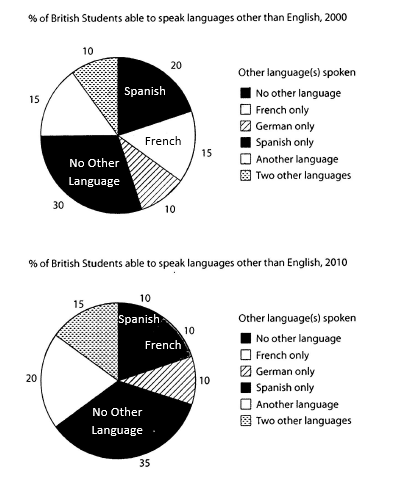
The charts below show the proportions of British students at one university in England who were able to speak other languages in addition to English, in 2000 and 2010
Summarise the information by selecting and reporting the main features, and make comparisons where relevant.
Student answer (Band 5.0)
THE TWO PIE CHART ILLUSTRATE THE INFORMATION ABOUT PERCENTAGE OF BRITISH STUDENTS AT ONE UNIVERSITY IN ENGLAND.STUDENT WHO WERE CAPABLE TO SPEAK OTHER LANGUAGE AS WELL AS ENGLISH IN 2000 AND 2010.
OVERALL, IT IS SEEN THAT, THE PERCENTAGE OF STUDENT IS HIGH IN NO OYHER LANGUAGE IN BOTH YEARS. GERMAN LANGUAGE IS SPEAK EQUALLY. HOWEVER,TWO OTHER LANGUAGE AND FRENCH IS INCREASE IN 2010.
TO BEGIN WITH,STUDENTS SPEAK NO OTHER LANGUAGE,WHICH WAS THE 30 % AND 35% IN 2000 AND 2010 RESPECTIVELY.15% STUDENTS WERE SPEAK FRENCH LANGUAGE IN 2000, IT DECREASE IN 2010, AND REACHED 10 % . 10 % GERMAN LANGUAGE WAS SPEAK BY BRITISH STUDENTS IN BOTH YEARS.
ACCORDING TO THE DATA,20 % STUDENTS SPEAKE SPANISH LANGUAGE IN 2000 .IT DECLINED AND REACHED 10 % IN 2010. AFTER THAT, ANOTHER LANGUAGE SPEAK BY STUDENTS WERE 15 % AND 20% IN 2000 AND 2010 RESPECTIVELY.TWO OTHER LANGUAGE SPEAK BY STUDENTS WERE 10% AND 15
AI examiner evaluation
| Criterion | Band |
|---|---|
| Task Achievement / Task Response | 5.0 |
| Coherence and Cohesion | 5.5 |
| Lexical Resource | 5.0 |
| Grammatical Range and Accuracy | 4.5 |
| Overall | 5.0 |
Task Achievement / Task Response: Band 5.0
You identify the main categories and report several accurate comparisons, including the rise in “No other language” from 30% to 35%, the fall in Spanish from 20% to 10%, and German remaining at 10%. The overview also recognises that “No other language” is the largest category in both years. However, the overview is partly inaccurate: French decreased, rather than increased, and the statement that two other languages increased is not clearly expressed. The final figure for this category is also left incomplete (“15”), and the response does not fully summarise the data. It is 148 words, two words below the 150-word minimum. Check every trend and complete all comparisons before finishing.
Coherence and Cohesion: Band 5.5
The response has a recognisable structure: an introduction, an overview, and two paragraphs presenting figures. This helps the reader follow the broad comparison, and phrases such as “To begin with” and “According to the data” signal movement between points. However, progression within paragraphs is sometimes abrupt, and the linking phrases do not always clarify how the information relates. For example, “After that” introduces another category but does not indicate a meaningful sequence in the chart. The final sentence is unfinished, which disrupts the ending and leaves the last comparison incomplete. Group related increases and decreases more deliberately, and use clear transitions to compare 2000 with 2010.
Lexical Resource: Band 5.0
You use relevant chart vocabulary, including “percentage,” “declined,” “reached,” and “respectively,” and the reader can generally identify the language categories being discussed. However, the range is limited and several word choices or collocations are inaccurate, such as “capable to speak,” “German language was speak,” and “two other language speak by students.” These expressions make parts of the report difficult to read naturally. There are also spelling and form errors, including “oyher” and “speake.” Aim to use precise reporting phrases consistently, such as “the proportion of students who spoke…” and “the figure rose/fell to…”. Check spelling and plural forms when proofreading.
Grammatical Range and Accuracy: Band 4.5
The response attempts a few longer structures, including “Students speak no other language, which was the 30% and 35%…” and a sentence describing the French figure’s change. However, sentence structures are limited, and errors occur frequently in verb forms, agreement, articles, and sentence boundaries. For example, “students were speak French” should use a past-tense form such as “students spoke French,” while “German language was speak” has an incorrect passive construction. The opening also runs two sentences together after “England.” Capitalisation and spacing around punctuation are inconsistent. Practise accurate simple comparison sentences first, then combine them with clauses using “while” or “whereas” once the verb forms are secure.
See this exact question answered at other band scores. The same prompt compared across bands.
Browse more IELTS Writing model answers or get your own writing scored by the same AI examiner.