Band 5.5 IELTS Writing Task 1 Model Answer
Overall Band Score: 5.5 · Cambridge IELTS 11 · 2026-11-20
IELTS Writing Task 1 question
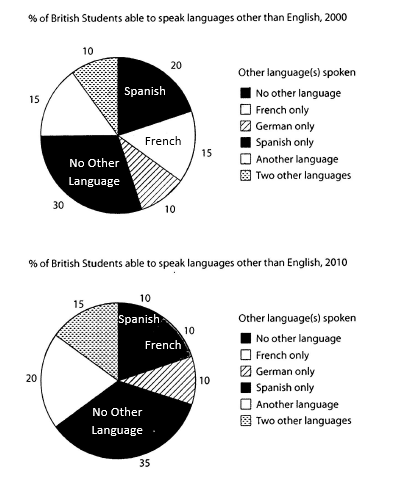
The charts below show the proportions of British students at one university in England who were able to speak other languages in addition to English, in 2000 and 2010
Summarise the information by selecting and reporting the main features, and make comparisons where relevant.
Student answer (Band 5.5)
The pie charts compare the percentage of British students, Who were able to speak language other than english at one university in England in 2000 and 2010.
Overall, The highest number of students who were able to talk only English in both years, and this ratio rose in 2010.While, the percentage of only Spanish and only French spoken students number declined. Two other spoken lanaguage students and another lanaguage spoken students number also raised. Whereas, Students who knew only German remained steady.
In 2000, The number of student who were able to speak only English, their number was highest, 30%. Large portion of students also talked in spanish only and it was 20%. Students who know only other language beside english and students who were able to speak only French, their percentage was 15%. As well as, 10% of students were able to speak in German only and same percentage of students talked two others language beside English.
In 2010, The percentage of students who were able to speak only English had raised to 35%. and Only German, Spenish and Fre
AI examiner evaluation
| Criterion | Band |
|---|---|
| Task Achievement / Task Response | 6.0 |
| Coherence and Cohesion | 5.0 |
| Lexical Resource | 5.0 |
| Grammatical Range and Accuracy | 5.0 |
| Overall | 5.5 |
Task Achievement / Task Response: Band 6.0
You identify the main overall changes: the share reporting no other language rises, Spanish and French fall, and German stays unchanged. The figures you give for 2000 and the 2010 no-other-language category are accurate, and you make relevant comparisons. However, the overview says “the highest number” spoke only English, which is not a precise description of the chart category “No other language”; it is the largest group, but the chart does not say these students spoke only English. The final paragraph is also incomplete, ending at “Spenish and Fre…”, so the 2010 breakdown is not fully reported. Develop that comparison by giving the remaining figures, especially the increases in another language and two other languages.
Coherence and Cohesion: Band 5.0
The response has a recognisable structure, with an overview followed by separate paragraphs for 2000 and 2010, and the reader can follow the broad comparison. However, progression is weakened by repeated, list-like phrasing such as “Students who…” and “their number,” while connectors including “While,” “Whereas,” and “As well as” are not consistently integrated into complete sentences. The 2010 paragraph stops abruptly, leaving the comparison unfinished and disrupting the overall flow. Grouping the data more deliberately—for example, first describing the largest category, then the categories that rose or fell—would create clearer progression. Use linking words within complete sentences and ensure each paragraph develops a complete point.
Lexical Resource: Band 5.0
You use relevant chart vocabulary, including “percentage,” “declined,” “remained steady,” and “rose,” which helps communicate the main trends. However, the range is limited and several expressions are repetitive or imprecise: “students number,” “talked in Spanish,” and “two others language” do not describe the data naturally. “Only English” is also an inaccurate label for the chart’s “No other language” category. Spelling errors such as “lanaguage” and “Spenish,” together with inconsistent capitalisation of language names, reduce accuracy. Aim for standard reporting collocations such as “the proportion of students,” “spoke Spanish,” and “students who spoke two other languages,” and use the chart’s category labels consistently.
Grammatical Range and Accuracy: Band 5.0
You attempt both simple statements and longer comparisons, and the main direction of change is generally understandable. However, sentence control is inconsistent, particularly in longer constructions. For example, “In 2000, The number of student …, their number was highest, 30%” combines an incomplete opening with a repeated subject, while “While, the percentage … declined” is not a complete sentence. There are also errors in articles, number agreement, and punctuation, as in “the number of student” and the full stop after “35%.” followed by “and.” The final sentence is unfinished, which further limits grammatical control. Build complete sentences around a clear subject and verb, check singular/plural forms, and connect contrasting clauses without leaving fragments.
See this exact question answered at other band scores. The same prompt compared across bands.
Browse more IELTS Writing model answers or get your own writing scored by the same AI examiner.