Band 5.0 IELTS Writing Task 1 Model Answer
Overall Band Score: 5.0 · Cambridge IELTS 11 · 2026-11-22
IELTS Writing Task 1 question
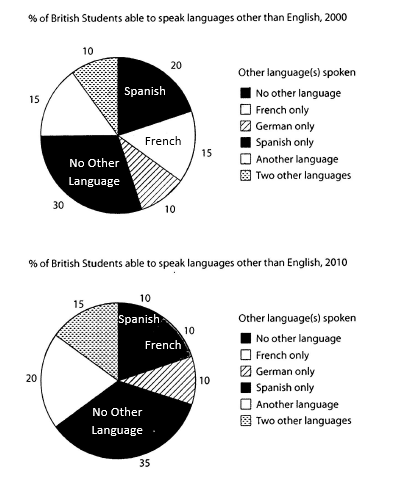
The charts below show the proportions of British students at one university in England who were able to speak other languages in addition to English, in 2000 and 2010
Summarise the information by selecting and reporting the main features, and make comparisons where relevant.
Student answer (Band 5.0)
THE TWO PIE CHARTS DEMONSTARTES THE BRITISH STUDENTS WHO WERE ABLE TO SPEAK FORIENG LANGUAGES IN 2000 AND 2010. IF WE PUT OUR EYE ON 2000 SURVEY 30% OF BRITISH DTUDENTS NOT ABLE TO SPEAK ANY OTHER LANGUAGE THAN ENGLISH HOWEVER 20% OF STUDENT SPEAK SPANISH AND 15 % SPEAK FRENCH AND 10 % OF PUPIL SPEAK GERMAN SO 25% OF LANGUAGE WHICH ARE SPOKEN ARE DIFFERENT THEN OTHERS.IF WE SEE YEAR 2010 THE NUMBER OF SPOKEN LANGUAGES DECLINE FOR EXAMPLE 10% OF LANGUAGE WHICH ARE SPOKEN ARE FRENCH,SPANISH AND GERMAN . IF WE MOVE FORWARD TO NO OTHER LANGUAGE IT INCREASE BY 5% ONLY 15% SPEAK ONLY TWO OTHER LANGUAGES SO THERE ARE BIG DIFFERNECE BETWEEN LANGUAGES WHICH ARE SPOKEN THROUGHOUT THE 10 YEARS IF MAKE COMPARION 5% INCREASE IN ANOTHER LANGUAGE SPEAKER AND NO OTHER LANGUAGE SPEAKER MOREOVER 10% DECREASE IN SPANISH LANGUAGE SPEAKERAND 5% DECREASE IN FRENCH LANGUAGE SPEAKER BECAUSE THE WORLD CHANGES THE PEOPLE ARE NOT INTRESTED IN LEARNING NEW LANGUAGES THEN BEFORE
AI examiner evaluation
| Criterion | Band |
|---|---|
| Task Achievement / Task Response | 5.5 |
| Coherence and Cohesion | 5.0 |
| Lexical Resource | 4.5 |
| Grammatical Range and Accuracy | 5.0 |
| Overall | 5.0 |
Task Achievement / Task Response: Band 5.5
You identify several important figures and changes, including the 30% with no other language in 2000, the rise to 35% in 2010, and the fall in Spanish from 20% to 10%. However, the response does not give a clear, accurate overview of the main pattern across both charts. In particular, the claim that “the number of spoken languages decline” is too broad: German remains at 10%, while “another language” and “two other languages” both increase. The statement that 25% spoke “different” languages in 2000 is unclear, and the final explanation that people are less interested in learning languages is unsupported by the charts. Select the main contrasts and report them neutrally, without inferring causes.
Coherence and Cohesion: Band 5.0
The response follows a basic chronological order, moving from 2000 to 2010, and uses some linking expressions such as “however,” “for example,” and “moreover.” This gives the reader a general sense of the comparison. However, there is no clear paragraphing or distinct overview, and the progression becomes difficult to follow in the long, run-on sequence beginning “If we see year 2010.” Several transitions, including “If we put our eye on” and “If we move forward,” are repetitive and do not clarify how the figures relate. Group the information into an introduction, an overview, and comparison paragraphs, and use links to show specific increases, decreases, or unchanged figures.
Lexical Resource: Band 4.5
You use some task-related vocabulary, including “increase,” “decrease,” “speak,” and “languages,” so the topic is generally understandable. However, the range is limited and several phrases are inaccurate or awkward, such as “put our eye on,” “number of spoken languages decline,” and “25% of language which are spoken are different then others.” Spelling errors such as “DEMONSTARTES,” “FORIENG,” and “DIFFERNECE” also make the writing less clear. Some expressions, including “language speaker,” are not natural ways to describe the chart categories. Build a more precise set of terms for proportions and comparisons, and check spelling and collocations before submitting.
Grammatical Range and Accuracy: Band 5.0
The response attempts to connect ideas in longer sentences, but these structures are often faulty, and sentence boundaries are not controlled consistently. For example, “If we see year 2010 the number of spoken languages decline” has problems with the article, tense, and subject–verb agreement. In “it increase by 5%,” the verb form is also incorrect. Missing punctuation creates run-on sentences, particularly in the final comparison, making relationships between clauses harder to follow. Most sentences rely on simple patterns or loosely joined clauses, so the range is limited. Practise accurate comparative sentences, such as “The proportion speaking Spanish fell from 20% to 10%,” and use full stops to separate complete ideas.
See this exact question answered at other band scores. The same prompt compared across bands.
Browse more IELTS Writing model answers or get your own writing scored by the same AI examiner.