Band 5.0 IELTS Writing Task 1 Model Answer
Overall Band Score: 5.0 · Cambridge IELTS 11 · 2026-11-22
IELTS Writing Task 1 question
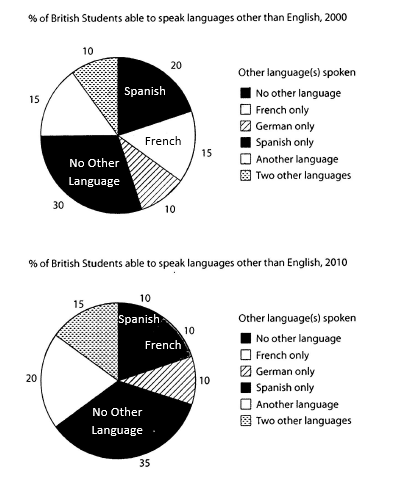
The charts below show the proportions of British students at one university in England who were able to speak other languages in addition to English, in 2000 and 2010
Summarise the information by selecting and reporting the main features, and make comparisons where relevant.
Student answer (Band 5.0)
The pie chart illustrates the percentage of British students at a university in England who were able to speak languages other than English, in 2000 and 2010. The highest percentage was contributed by English speakers (which is 30%) in 2000, followed by 35 % in 2010 .
In 2000, People who knew German and two other languages comprised 10% of the total data, whereas in 2010 the figure remained the same for German but increased to 20% for two other languages.
AI examiner evaluation
| Criterion | Band |
|---|---|
| Task Achievement / Task Response | 4.0 |
| Coherence and Cohesion | 5.5 |
| Lexical Resource | 5.5 |
| Grammatical Range and Accuracy | 5.5 |
| Overall | 5.0 |
Task Achievement / Task Response: Band 4.0
The response identifies the topic and makes a comparison between the two years, but it reports only a small part of the chart and does not provide a clear overview of the main changes. The statement that “English speakers” accounted for 30% and then 35% misidentifies the category: these figures refer to students who spoke no other language. The claim that “two other languages” rose to 20% is also inaccurate; it increased from 10% to 15%, while “another language” rose to 20%. The response is substantially below the required 150 words, which leaves most categories and comparisons unreported. Include the key rises and falls, and accurately distinguish the language categories.
Coherence and Cohesion: Band 5.5
The response has a basic two-part structure: an opening sentence introduces the charts, followed by a paragraph with selected figures. The use of “whereas” also signals a comparison between years. However, the information does not progress into a complete summary: there is no developed overview, and the second paragraph moves directly to German and two other languages without linking these details to the main pattern. The phrase “followed by 35% in 2010” is also unclear because it does not explicitly name the category. Organise the response around an overview and then group the most important increases, decreases, and unchanged figures, using clear references to each category.
Lexical Resource: Band 5.5
The vocabulary is sufficient to communicate the general subject, with relevant terms such as “percentage,” “comprised,” and “remained the same.” However, the range is limited, and some choices are imprecise for describing the chart. “English speakers” incorrectly labels the no-other-language category, while “total data” is an unnatural way to refer to the student population. Capitalisation is also inconsistent in “People.” Use the chart’s category labels accurately and vary reporting language with expressions such as “accounted for,” “stood at,” and “the proportion of students speaking.” More precise wording would make the comparisons easier to understand.
Grammatical Range and Accuracy: Band 5.5
The response uses a mixture of simple statements and a more complex comparison with “whereas,” and the main meaning is generally understandable. There are, however, some errors and awkward constructions. In “The highest percentage was contributed by English speakers,” the passive form is unnatural for reporting a chart; a direct construction such as “The largest group was students who spoke no other language” is clearer. The sentence ending “followed by 35% in 2010” lacks a clear grammatical reference to what the percentage represents. Spacing around percentages and commas is inconsistent, and “People” is unnecessarily capitalised mid-sentence. Aim for complete, clearly referenced comparisons and consistent punctuation.
See this exact question answered at other band scores. The same prompt compared across bands.
Browse more IELTS Writing model answers or get your own writing scored by the same AI examiner.