Band 4.5 IELTS Writing Task 1 Model Answer
Overall Band Score: 4.5 · Cambridge IELTS 11 · 2026-11-23
IELTS Writing Task 1 question
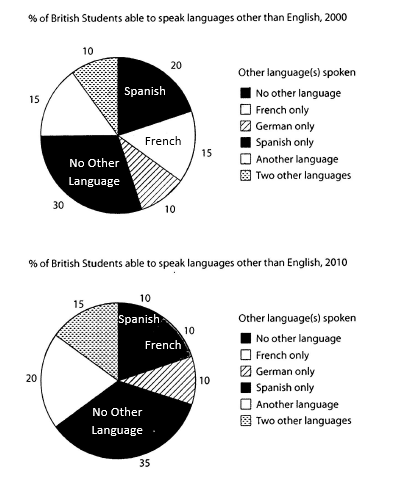
The charts below show the proportions of British students at one university in England who were able to speak other languages in addition to English, in 2000 and 2010
Summarise the information by selecting and reporting the main features, and make comparisons where relevant.
Student answer (Band 4.5)
The pie charts illustrates percentages of british students at one university in England who were able to speak languages other than English, in 2000 and 2010.
Overall, A lot of students only spoke English language.Some students spoke spanish language but some small percentage of french students .
In 2010 the number of students who spoke English increases.
In 2000, A large number of students 30% spoke only no other language in university but 20% students speaks Spanish.10% students spoke only German language wheares 10% students spoke two other languages but 15% students only spoke French and another language .
In 2010, The students spoke English will be increase 5% in decades .
AI examiner evaluation
| Criterion | Band |
|---|---|
| Task Achievement / Task Response | 3.5 |
| Coherence and Cohesion | 4.5 |
| Lexical Resource | 4.5 |
| Grammatical Range and Accuracy | 4.5 |
| Overall | 4.5 |
Task Achievement / Task Response: Band 3.5
You identify the chart topic and include several relevant figures, such as 30% speaking no other language and 20% speaking Spanish in 2000. However, the overview is unclear and includes a major misreading: the charts show students’ ability to speak other languages, not an increase in the number who spoke English. In 2010, the no-other-language category rose from 30% to 35%, while Spanish fell from 20% to 10%; these key changes are not accurately summarised. Some 2010 categories are omitted, and the description of French and “another language” is ambiguous. The response is also 99 words, below the 150-word minimum. Add a clear overview and compare the main categories across both years using accurate figures.
Coherence and Cohesion: Band 4.5
The response has a basic structure: an introduction, an attempted overview, and separate paragraphs beginning “In 2000” and “In 2010.” This gives the reader some sense of how the information is organised. However, progression is limited because the final paragraph repeats the claim about English rather than completing the comparison of the chart categories. Connections between figures are often abrupt, as in “Spanish.10% students,” and there is little linking language to show contrasts or changes. The overview also combines several ideas without clear relationships. Use complete, clearly separated sentences and organise the body around comparable categories or the main increases and decreases; this would make the progression easier to follow.
Lexical Resource: Band 4.5
You use some task-relevant vocabulary, including “percentages,” “spoke,” and “increases,” so the basic subject is recognisable. However, the range is narrow and repetitive, with “students spoke” used repeatedly and imprecise phrases such as “only no other language” and “English language.” Some word choices also confuse the chart’s meaning: the data concern students speaking languages in addition to English, not the number who “spoke English.” Capitalisation and spelling are inconsistent, including “british” and “spanish.” Aim for precise chart language such as “accounted for,” “rose,” “fell,” and “the proportion speaking no other language,” while checking standard spelling and avoiding repeated sentence patterns.
Grammatical Range and Accuracy: Band 4.5
Most sentences use simple structures, and the reader can understand the general topic, but grammatical control is inconsistent. The opening has subject–verb disagreement: “The pie charts illustrates” should be “The pie charts illustrate.” Tense and verb forms are also faulty in “20% students speaks Spanish” and “the students spoke English will be increase.” Articles and sentence boundaries need attention, as in “only spoke English language.Some students,” where a space and clearer sentence structure are needed. There is little variety beyond basic statements, and these errors make some comparisons difficult to interpret. Practise accurate past-tense descriptions and simple comparative forms before adding more complex sentences.
See this exact question answered at other band scores. The same prompt compared across bands.
Browse more IELTS Writing model answers or get your own writing scored by the same AI examiner.