Band 4.5 IELTS Writing Task 1 Model Answer
Overall Band Score: 4.5 · Cambridge IELTS 11 · 2026-11-23
IELTS Writing Task 1 question
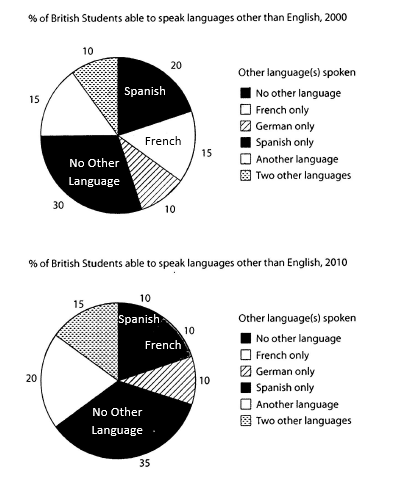
The charts below show the proportions of British students at one university in England who were able to speak other languages in addition to English, in 2000 and 2010
Summarise the information by selecting and reporting the main features, and make comparisons where relevant.
Student answer (Band 4.5)
introduction, the charts illustrate the proportions off british students at university in england who were able to speake other languages in addition to english in 2000 and 2010.
overall , the british students at university in england were able to speake other language in addition to english . spanish language are spoken more then other languages, in 2000 year students spoke spanish language but in 2010 students are able to speake spanish and french at this time .
in 2000 stuudents are able to speake spanish and german,fench and other languages but the percentage of british students able to speake languages other than english other hand in 2010 students they able to speake spanish and french language more then 2000 , german language are increase also french increase this year more then 2000,
2010 students are able to speake in many languages , these are increase this year other languages increase 35%,french languages are more this year
AI examiner evaluation
| Criterion | Band |
|---|---|
| Task Achievement / Task Response | 3.5 |
| Coherence and Cohesion | 4.5 |
| Lexical Resource | 4.5 |
| Grammatical Range and Accuracy | 4.5 |
| Overall | 4.5 |
Task Achievement / Task Response: Band 3.5
The response identifies the two years and attempts an overview, but it does not accurately summarise the main patterns. The claim that Spanish was spoken more than other languages in 2000 is not a clear comparison of the chart categories, and the statement that Spanish and French were spoken more in 2010 reverses the data: Spanish fell from 20% to 10%, while French fell from 15% to 10%. German stayed at 10%; “another language” and two other languages rose, and the share speaking no other language increased from 30% to 35%. These key features are mostly missing or misreported. The response is also 147 words, below the required 150; the 10 words copied from the prompt were excluded from the count. Select and compare the largest changes accurately.
Coherence and Cohesion: Band 4.5
There is a basic attempt to organise the response into an introduction, an overview and detail paragraphs, so the reader can recognise a report structure. However, progression is weak: the second paragraph makes broad claims, while the later paragraphs repeat that students spoke several languages without clearly grouping or comparing the figures. Connectors such as “but,” “also” and “other hand” do not reliably show the relationship between ideas, and the final paragraph repeats points already made rather than adding a clear comparison. Improve cohesion by grouping categories that rose, fell or stayed unchanged, and use clear references such as “By contrast” and “Meanwhile.” A concise overview followed by two logically ordered comparison paragraphs would make the information easier to follow.
Lexical Resource: Band 4.5
The response uses a small set of relevant terms, including “proportions,” “percentage,” “increase” and “languages,” which helps establish the topic. However, vocabulary is repetitive and often imprecise: “more then” is used where a comparison is intended, and “other languages” does not distinguish “another language” from “two other languages” in the chart. There are also frequent spelling errors, including “speake,” “stuudents” and “fench,” which reduce the accuracy and polish of the report. Use the chart’s category labels consistently and choose precise verbs such as “rose,” “fell” and “remained unchanged.” Proofreading spelling and avoiding repeated phrases would make the data description clearer.
Grammatical Range and Accuracy: Band 4.5
The writer attempts both simple statements and longer sentences, and the opening sentence communicates the general subject. However, sentence control is inconsistent, particularly in longer clauses. For example, “in 2000 students spoke Spanish language but in 2010 students are able to speake Spanish and French” shifts tense and does not form a clear comparison. Subject–verb agreement is also unreliable in “Spanish language are spoken” and “German language are increase.” Articles and sentence boundaries are often missing or misplaced, as in the run-on final paragraph. Use past simple consistently for both chart years, check singular and plural subjects, and separate each comparison into a complete sentence. These changes would improve accuracy while retaining the writer’s attempts at varied sentence forms.
See this exact question answered at other band scores. The same prompt compared across bands.
Browse more IELTS Writing model answers or get your own writing scored by the same AI examiner.