Band 5.5 IELTS Writing Task 1 Model Answer
Overall Band Score: 5.5 · Cambridge IELTS 11 · 2026-11-23
IELTS Writing Task 1 question
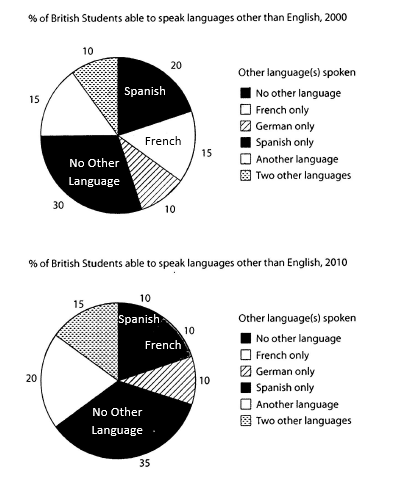
The charts below show the proportions of British students at one university in England who were able to speak other languages in addition to English, in 2000 and 2010
Summarise the information by selecting and reporting the main features, and make comparisons where relevant.
Student answer (Band 5.5)
The pie charts demonstrate the percentages of British students in England who were able to speak languages other than English, in 2000 and 2010.
Overall, the proprtion of the students who were able to speak no other language was almost the same in both years. A small share of the students were able to spoke German only in those years.
In 2000, 30% of British students were not able to spoke other language and that proportion remained almost the same in 2010. 15% of the students were able to speak French langugae in 2000 whereas in 2010, only 10% of the students spoke this language. The proportion of the German only language stayed same in both years, which was 10%.
Furthermore, 20% students can spoke Spanish only in England in 2000, in contrast, the half of the proportion can spoke this in 2010. 15% and 20% of the students were able to speak another language in the year 2000 and 2010 respectively. Students who can speak two other languages was 10% in 2000 and 15% in 2010.
AI examiner evaluation
| Criterion | Band |
|---|---|
| Task Achievement / Task Response | 5.5 |
| Coherence and Cohesion | 6.0 |
| Lexical Resource | 5.5 |
| Grammatical Range and Accuracy | 5.5 |
| Overall | 5.5 |
Task Achievement / Task Response: Band 5.5
You report most of the chart categories and several figures accurately, including French falling from 15% to 10%, German remaining at 10%, and the increases for another language and two other languages. However, the overview is unclear and partly inaccurate: saying the proportion with no other language was “almost the same” overlooks its rise from 30% to 35%. The overview also repeats the German figure rather than summarising the main overall pattern. Your description of Spanish correctly notes a halving, but could state the 2010 figure explicitly. To strengthen the response, give a concise overview that highlights the rise in students speaking no other language and the contrasting changes across language categories, then report the key figures precisely.
Coherence and Cohesion: Band 6.0
The response has a clear basic structure: an introduction, an overview, and paragraphs describing the figures. The information is generally grouped sensibly, and linking expressions such as “whereas,” “in contrast,” and “Furthermore” help signal comparisons. However, the overview does not clearly guide the reader through the main trends, and the final paragraph places several categories together without a strong organising principle. Some connections are also awkward, particularly the long sentence beginning “Furthermore, 20% students…” To improve progression, organise the details by trend—for example, categories that decreased, stayed stable, or increased—and use linking phrases to make those relationships explicit.
Lexical Resource: Band 5.5
You use relevant chart vocabulary, including “proportion,” “share,” “remained,” and “in contrast,” and the meaning is generally understandable. However, several word-choice, collocation, and spelling problems limit precision: “speak French language” is unnatural, “the half of the proportion” is unclear, and “proprtion” and “langugae” are misspelled. The repeated use of “able to speak” and “proportion” also makes the wording less flexible. Aim for accurate, natural phrases such as “the percentage of students speaking French” and “fell by half,” and check spelling carefully. A wider range of precise verbs, such as “rose,” “declined,” and “remained unchanged,” would make comparisons more concise.
Grammatical Range and Accuracy: Band 5.5
You attempt both simple and more complex sentences, including comparisons with “whereas” and “in contrast,” and the reader can usually follow the intended meaning. However, some errors in verb forms and sentence construction remain. For example, “were able to spoke” should be “were able to speak,” while “20% students can spoke” needs both an article or possessive construction and a correct verb form. In “Students who can speak two other languages was 10%,” the subject and verb do not agree, and the tense is inconsistent with the past-year data. Practise describing past figures consistently with “were,” “could,” or “accounted for,” and check agreement when the subject is a plural group.
See this exact question answered at other band scores. The same prompt compared across bands.
Browse more IELTS Writing model answers or get your own writing scored by the same AI examiner.