Band 5.5 IELTS Writing Task 1 Model Answer
Overall Band Score: 5.5 · Cambridge IELTS 11 · 2026-11-23
IELTS Writing Task 1 question
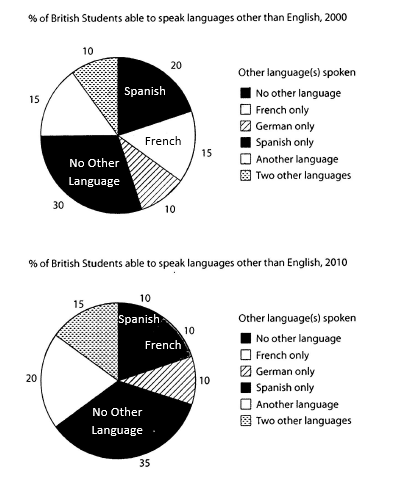
The charts below show the proportions of British students at one university in England who were able to speak other languages in addition to English, in 2000 and 2010
Summarise the information by selecting and reporting the main features, and make comparisons where relevant.
Student answer (Band 5.5)
The two pie charts illustrate the proportions of british students at a university in England who could speak other languages in additon to english across six categories, in 2000 and 2010.
Overall, no other language made the most contribution in both years, while another language and two other languages made slight increase over the period. Both spanish and french made significant decrease over the period in addition german remain the same.
In 2000, no other language contributed 30%, spanish language ranked second making up one-fifth 20%. Both german and two other language accounted for 10 %, also french and another language accounted for 15%.
AI examiner evaluation
| Criterion | Band |
|---|---|
| Task Achievement / Task Response | 5.0 |
| Coherence and Cohesion | 6.0 |
| Lexical Resource | 6.0 |
| Grammatical Range and Accuracy | 5.5 |
| Overall | 5.5 |
Task Achievement / Task Response: Band 5.0
You identify the main overall pattern accurately: “No other language” was the largest category in both years, and the shares for Spanish and French fell while “another language” and “two other languages” rose. The 2000 figures you report are also correct. However, the response is incomplete: it gives no specific 2010 figures and does not describe how the categories compare in that year, so the key changes are only stated generally. The overview also says the increases were “slight” without supporting this with data. The response is 104 words, below the required 150, which contributes to the limited coverage. To develop the report, include the 2010 percentages and compare the size of each change.
Coherence and Cohesion: Band 6.0
The response has a clear basic structure: an introduction, an overview, and a paragraph giving details for 2000. This makes the information easy to follow, and phrases such as “Overall” and “In 2000” help signal the stages of the report. However, the progression stops after the 2000 data; there is no corresponding detail paragraph for 2010, leaving the comparison unfinished. Some linking is also compressed into a single overview sentence, where several trends are listed without explaining their relationship. A fuller structure—overview followed by a paragraph comparing the two years—would make the organisation more complete and cohesive.
Lexical Resource: Band 6.0
You use a reasonable range of task-related vocabulary, including “proportions,” “categories,” “accounted for,” and “ranked second,” so the main information is generally clear. There are, however, some inaccurate or unnatural collocations: “made the most contribution” and “made significant decrease” are not natural ways to describe chart data. “Across six categories” is understandable, but “in six categories” would be more idiomatic. Spelling and capitalisation also need attention, including “british,” “english,” “additon,” and “spanish.” Aim for precise reporting verbs such as “accounted for,” “stood at,” and “increased,” and check spelling and proper nouns carefully.
Grammatical Range and Accuracy: Band 5.5
You produce several understandable sentences and attempt a complex overview using “while,” showing some range beyond simple statements. Some grammatical errors remain, though, and they occasionally make the phrasing awkward. For example, “Both spanish and french made significant decrease” needs a plural noun phrase (“significant decreases”) or a verb construction such as “both fell significantly.” In “german remain the same,” the verb should be past tense (“remained”), and “two other language” needs a plural noun (“languages”). The sentence beginning “Both german and two other language accounted for 10%” also combines categories in a way that makes the number agreement unclear. Use consistent past tense and check articles, plurals, and agreement.
See this exact question answered at other band scores. The same prompt compared across bands.
Browse more IELTS Writing model answers or get your own writing scored by the same AI examiner.