Band 6.0 IELTS Writing Task 1 Model Answer
Overall Band Score: 6.0 · Cambridge IELTS 11 · 2026-11-23
IELTS Writing Task 1 question
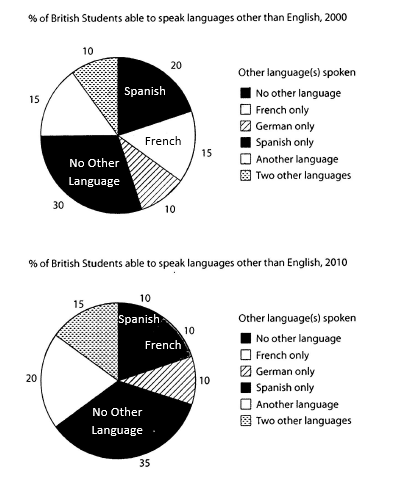
The charts below show the proportions of British students at one university in England who were able to speak other languages in addition to English, in 2000 and 2010
Summarise the information by selecting and reporting the main features, and make comparisons where relevant.
Student answer (Band 6.0)
The two charts below provide information about the percentage of British students who were able to speak various languages including English in England, in the year 2000 and 2010.
Overall, students who spoke no other language than English contributed a large proportion while German speakers were one of the least in numbers as compared to the other languages speakers. Whereas the proportion of another language speakers changed a little bit.
A majority of only English speaking students were 30% in 2000 which increased slightly to 35% in 2010. The French language speakers were 15% in 2000 which decreased 5% and remained 10% in 2010. Whereas German speaker pupils were 10% and Spanish speakers were 15% in 2000 from which German remained unchanged and Spanish decreased to 10% in 2010.
Some another language speaker students were 15% in 2000 and increased to 20% in the year 2010 while two other languages speaking students contributed with 10% in 2000 and gone up with increase in 5% in 2010.
AI examiner evaluation
| Criterion | Band |
|---|---|
| Task Achievement / Task Response | 6.0 |
| Coherence and Cohesion | 6.0 |
| Lexical Resource | 5.5 |
| Grammatical Range and Accuracy | 5.5 |
| Overall | 6.0 |
Task Achievement / Task Response: Band 6.0
You report the main categories and most figures accurately: for example, no other language rises from 30% to 35%, French falls from 15% to 10%, and the two-language group increases from 10% to 15%. The overview also identifies the largest group and notes change in the other-language category. However, the overview is not fully precise: German is unchanged at 10%, but it is not uniquely among the smallest groups, since French and Spanish are also at 10% in 2010. The opening also incorrectly says the charts include English among the languages; they show additional languages besides English. To strengthen the response, make the overview more exact and compare the main increases and decreases explicitly.
Coherence and Cohesion: Band 6.0
The response has a clear overall structure, moving from an introduction and overview to details about the figures. The information is generally grouped sensibly, and the reader can follow the comparisons between 2000 and 2010. However, cohesion is sometimes mechanical: several sentences begin with “Whereas,” creating fragments or awkward links, and the final paragraph uses “while” to connect two related changes without a fully clear comparison. Some references, such as “from which,” are also difficult to follow. Use complete sentences and organise the details into clearer groups—for example, increases in one paragraph and decreases or unchanged figures in another. This would make the progression smoother and the relationships between data points more explicit.
Lexical Resource: Band 5.5
You use relevant vocabulary for describing charts, including “proportion,” “increased,” “decreased,” and “remained unchanged,” so the meaning is generally clear. However, several word choices and collocations are awkward or imprecise, such as “least in numbers,” “another language speakers,” and “gone up with increase.” The phrase “including English” also misrepresents the categories shown. Repetition of “speakers” and “students” limits the range, while “a little bit” is too informal for an academic report. Aim for concise, conventional chart language and use category labels consistently, such as “students speaking another language” or “the proportion speaking two other languages.”
Grammatical Range and Accuracy: Band 5.5
You attempt a mix of simple and more complex sentence forms, and the main comparisons are usually understandable. Some grammatical errors remain, particularly in sentence construction and agreement. For example, “A majority of only English speaking students were 30%” uses an unsuitable verb structure, and “two other languages speaking students … gone up” has an incorrect participial construction and missing auxiliary. The clauses beginning “Whereas” are not complete sentences in this context, and “increased 5%” needs a grammatical comparison such as “increased by five percentage points.” Work on forming complete clauses, matching subjects and verbs, and using accurate comparative structures. These corrections would improve control without sacrificing sentence variety.
See this exact question answered at other band scores. The same prompt compared across bands.
Browse more IELTS Writing model answers or get your own writing scored by the same AI examiner.