Band 5.5 IELTS Writing Task 1 Model Answer
Overall Band Score: 5.5 · Cambridge IELTS 11 · 2026-11-23
IELTS Writing Task 1 question
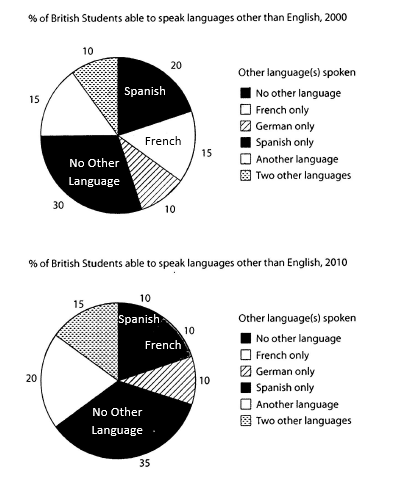
The charts below show the proportions of British students at one university in England who were able to speak other languages in addition to English, in 2000 and 2010
Summarise the information by selecting and reporting the main features, and make comparisons where relevant.
Student answer (Band 5.5)
The pie chart above illustrates the percentages of British students at one university in England who were able to communicate in other languages in addition to English, in 2000 and 2010.
Overall, different proportions of languages were recorded each year. 'No other language' recorded the highest percentage in both the years, whereas significant decrease was noticed in the figure of Spanish and French language, in 2010.
To be specific, in 2000, Spanish was spoken by 20% of the students, whereas 15% of the total preferred speaking French language. 'German language' and 'two other langauges' had same ratio, presenting 10% each, while 'another language' presented 15% of the total.
In 2010, the figure of Spanish and French language recorded a significant decrease, reaching to 10% each, while the proportion of German language remained unchanged. The ratio of 'another langauge' and 'two other languages' increased by 5%, reaching to 20% and 15%, respectively.
Moreover, 'no other language' represented highest figures in both the years, 30% and 35%.
AI examiner evaluation
| Criterion | Band |
|---|---|
| Task Achievement / Task Response | 5.5 |
| Coherence and Cohesion | 5.5 |
| Lexical Resource | 5.5 |
| Grammatical Range and Accuracy | 5.5 |
| Overall | 5.5 |
Task Achievement / Task Response: Band 5.5
You identify the main pattern that “No other language” was the largest category in both years, and you report the key figures accurately: it rose from 30% to 35%, while Spanish fell from 20% to 10% and French from 15% to 10%. You also note the increases in “another language” and “two other languages” and the unchanged German figure. However, the overview is brief and partly repetitive, and the response does not clearly compare the overall distribution beyond listing changes. The required minimum was not met: the response contains 143 words, seven short of 150, with 22 words copied from the prompt excluded. Develop the overview and comparisons further, and ensure the report reaches the minimum length.
Coherence and Cohesion: Band 5.5
The response has a recognisable structure: an introduction, an overview, and separate paragraphs describing the two years. This makes the figures reasonably easy to follow, and transitions such as “To be specific” and “In 2010” signal the movement between details. However, the progression is somewhat list-like, and the final sentence repeats the overview’s point about “no other language” rather than adding a new comparison. Some linking is mechanical, particularly the repeated use of “while.” Group related changes into clearer comparisons—for example, the categories that declined, those that increased, and the unchanged category—and avoid repeating information. This would create a more developed progression while retaining the clear paragraph structure.
Lexical Resource: Band 5.5
You use relevant vocabulary for describing proportions and change, including “percentages,” “proportion,” “remained unchanged,” and “increased.” These choices make the main trends understandable. However, some expressions are awkward or repetitive, such as “preferred speaking French language,” “reaching to 10%,” and “recorded a significant decrease.” The spelling errors “langauges” and “langauge” also reduce accuracy. In addition, “significant” may imply statistical importance that the chart does not establish; “marked” or simply “fell” would be more appropriate. Aim for precise chart-reporting collocations and vary the language used to describe figures, rather than repeatedly saying “figure” or “ratio.”
Grammatical Range and Accuracy: Band 5.5
You attempt a mix of sentence forms, including comparisons with “whereas” and clauses joined by “while,” and the overall meaning is generally clear. However, grammatical control is uneven. For example, “Spanish and French language recorded a significant decrease” has a subject–verb agreement problem and an awkward singular construction; “the figures for Spanish and French decreased” would be clearer. “German language and two other langauges had same ratio” also needs an article before “same ratio,” while “reaching to 10%” uses an incorrect preposition in this pattern. The overview’s “in both the years” is another awkward grammatical construction. Review agreement, articles, and verb-plus-preposition patterns, and proofread sentence structures carefully.
See this exact question answered at other band scores. The same prompt compared across bands.
Browse more IELTS Writing model answers or get your own writing scored by the same AI examiner.