Band 6.0 IELTS Writing Task 1 Model Answer
Overall Band Score: 6.0 · Cambridge IELTS 11 · 2026-11-23
IELTS Writing Task 1 question
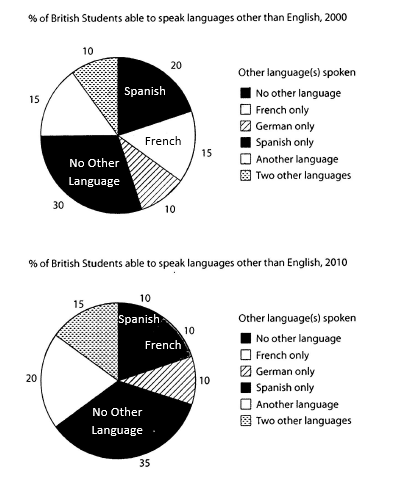
The charts below show the proportions of British students at one university in England who were able to speak other languages in addition to English, in 2000 and 2010
Summarise the information by selecting and reporting the main features, and make comparisons where relevant.
Student answer (Band 6.0)
The pie charts illustratet how many students were able to speak other languages in addition to English at a university in England, in 2000 and 2010.
Overall, the highest number of students were able to speak French and Spanish, but most of the students did not know more than one language in addition to English.
In 2000, 20 percent of students knew Spanish which was the highest speaking language. Additionally, the second most spoken language was French, accounting for 15 percent. Furthermore, 10 percent of students were recorded in German. Students who could speak more than two languages, stood at 10 percent, but 30 percent of student did not know any other language.
For the year 2010, the proportion of students speaking Spanish language decreased to 10 percent, the percentage speaking french increased to 20 percent which was the widely spoke language in 2010. Moreover, students who did not know any other language increased as well in this year and jumped to 35 percent. There was a minor jump in another language, which stood at 15 percent, while other categories remained the same.
AI examiner evaluation
| Criterion | Band |
|---|---|
| Task Achievement / Task Response | 5.5 |
| Coherence and Cohesion | 6.5 |
| Lexical Resource | 6.0 |
| Grammatical Range and Accuracy | 6.0 |
| Overall | 6.0 |
Task Achievement / Task Response: Band 5.5
You identify the two years and report several key figures, including Spanish at 20% in 2000 falling to 10% in 2010 and the share with no other language rising from 30% to 35%. However, the overview is not fully accurate: French and Spanish were not the highest overall in both years, and “most ... did not know more than one language” does not clearly describe the chart. In 2010, French was 10%, not 20%; the 20% figure belongs to “another language.” You also say other categories remained the same, although “two other languages” rose from 10% to 15%. Report the categories consistently and make the overview reflect the main shifts more precisely.
Coherence and Cohesion: Band 6.5
The response has a clear overall arrangement: an introduction, an overview, and separate paragraphs for 2000 and 2010. This makes the comparison easy to follow, and linking expressions such as “Additionally,” “Furthermore,” and “Moreover” help signal added information. The progression is generally coherent, but some connections are mechanical, and the overview’s claim about students knowing “more than one language” is not clearly tied to the chart categories. The final sentence, “while other categories remained the same,” also conflicts with the earlier figures, weakening the paragraph’s logic. To strengthen cohesion, group the categories that increased, decreased, or stayed unchanged, and use precise references to the chart labels.
Lexical Resource: Band 6.0
You use a suitable range of chart vocabulary, including “accounting for,” “proportion,” “decreased,” and “increased,” and the meaning is generally clear. There are, however, several inaccurate or awkward choices that reduce precision. “Highest number” is less suitable for percentages than “largest proportion,” while “highest speaking language” and “widely spoke language” are unnatural collocations. “Another language” is also a chart category, so avoid using it loosely when describing the data. There are spelling and form slips, including “illustratet” and “french.” Aim for accurate, consistent labels and natural collocations; this will make your comparisons sound more precise and appropriately academic.
Grammatical Range and Accuracy: Band 6.0
You use a mix of simple and more complex sentence forms, for example, “Spanish, which was the highest speaking language” and “Students who could speak more than two languages, stood at 10 percent.” Most sentences remain understandable, but some grammatical choices are inaccurate. The comma in “languages, stood” separates the subject from its verb, and “30 percent of student did not know” needs a plural noun. In “the percentage speaking french increased to 20 percent which was...,” the relative clause is awkwardly attached and needs clearer punctuation or restructuring. The sentence patterns are varied enough to communicate comparisons, but careful checking of agreement, clause structure, and punctuation would improve control.
See this exact question answered at other band scores. The same prompt compared across bands.
Browse more IELTS Writing model answers or get your own writing scored by the same AI examiner.