Band 4.5 IELTS Writing Task 1 Model Answer
Overall Band Score: 4.5 · Cambridge IELTS 11 · 2026-11-24
IELTS Writing Task 1 question
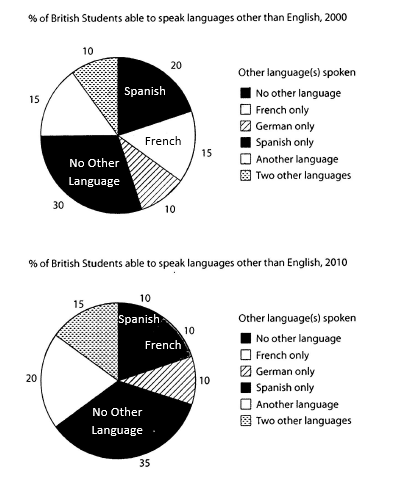
The charts below show the proportions of British students at one university in England who were able to speak other languages in addition to English, in 2000 and 2010
Summarise the information by selecting and reporting the main features, and make comparisons where relevant.
Student answer (Band 4.5)
"The pie chart illustrates the different percentages of British students at one universty in
England who were capable to speak other langauges besides English in 2000 and
2010.Overall,no other langauge accounted for the highest percentage 30%.
whereas German language stood at 10%lowest.
Spanish accounted for 20%,whereas the proportion of french 15%.
Two another languages made up 10%.
Some other changes of british students were able to speak languages other than
English.
Although the languages spoken of Spanish ,french and german only were accounted for
10% remained the same,the other categories changed.
Another language stood at 20%,whereas two other langauges propotion was 15%.
No other langauge was 10%.
No other language was higher than another language,whereas Another language was lower
than german only language.And the german language is lower than spanish,french and
german only language."
AI examiner evaluation
| Criterion | Band |
|---|---|
| Task Achievement / Task Response | 4.0 |
| Coherence and Cohesion | 3.5 |
| Lexical Resource | 5.0 |
| Grammatical Range and Accuracy | 5.0 |
| Overall | 4.5 |
Task Achievement / Task Response: Band 4.0
You identify the two years and report several relevant figures, including Spanish at 20% in 2000 and 10% in 2010, and “another language” rising to 20%. However, the response only partially summarises the charts: it lacks a clear overview of the main changes, and some comparisons are inaccurate or confusing. For example, “No other language was 10%” misreports the 2010 figure, which was 35%, while the claim that another language was lower than German is also incorrect. The final comparison repeats German and does not clarify the data. The response is also 16 words below the required minimum. To improve, give a concise overview, accurately compare the largest categories and changes, and check every figure against the chart.
Coherence and Cohesion: Band 3.5
There is a basic attempt to separate information about 2000 from changes in 2010, and words such as “whereas” and “Although” show an effort to connect ideas. However, the progression is difficult to follow because the response has several isolated statements and no clear overview paragraph. The transition “Some other changes” does not specify which year or establish a useful comparison, and the final sentences repeat categories while making their relationships unclear. Paragraph breaks are frequent but do not consistently group related information. Organise the response into an introduction, an overview of the main trends, and two short comparison paragraphs. Use linking expressions only where the relationship is clear, and avoid repeating the same category without adding a new comparison.
Lexical Resource: Band 5.0
You use some task-relevant vocabulary, including “percentage,” “accounted for,” “proportion,” and “stood at,” which helps communicate chart information. However, the range is limited and several word-choice, form, and spelling problems reduce precision. Examples include “Two another languages,” “langauges,” “propotion,” and “capable to speak”; these make parts of the report harder to understand. “No other language” is also repeated often, and “German language” is less precise than the chart label “German only.” Build a small set of accurate chart-reporting phrases and use them consistently, such as “the share of students speaking…,” “rose from…to…,” and “remained unchanged.” Check spelling and use the category labels exactly.
Grammatical Range and Accuracy: Band 5.0
The response attempts some complex sentence forms, for example, “Although the languages spoken of Spanish, french and german only were accounted for 10% remained the same,” and uses comparison structures such as “whereas.” However, these attempts are often faulty, and the limited sentence patterns make relationships difficult to follow. In the quoted sentence, the “although” clause is not completed correctly, and the subject and verb structure is unclear. Other examples include “German language stood at 10%lowest,” which lacks a clear grammatical construction, and inconsistent punctuation where sentences run together, as in “2010.Overall.” Aim first for accurate simple sentences with a clear subject and verb, then add controlled comparisons using “while” or “whereas.”
See this exact question answered at other band scores. The same prompt compared across bands.
Browse more IELTS Writing model answers or get your own writing scored by the same AI examiner.