Band 5.0 IELTS Writing Task 1 Model Answer
Overall Band Score: 5.0 · Cambridge IELTS 11 · 2026-11-24
IELTS Writing Task 1 question
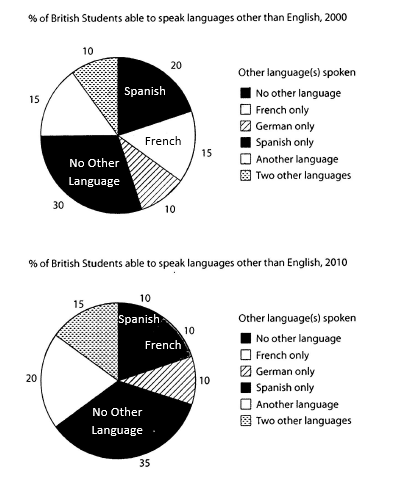
The charts below show the proportions of British students at one university in England who were able to speak other languages in addition to English, in 2000 and 2010
Summarise the information by selecting and reporting the main features, and make comparisons where relevant.
Student answer (Band 5.0)
The pie chart illustrates the sheer of British students at a higher education institute in England who were fluent in many languages including English in 2000 and 2010.
In previous decade, there were about half of the total peers who speak spanish and those who were not known to any other language. while in next decade, the number of infants who speak only spanish became half. The number of students who speaks many languages increased in considerable figures.
In 2000, there were 30% of children who did not speaks any other language while only spanish speakers were 20%. There were 15% of both french speakers and another language speakers and total of 30%.
In 2010, there was a drop in only spanish speakers and only french speakers, now they became 10% and total of 20%. While those who speaks no other languages are increased by 5%from previous decade.
The German speakers figure remain same in both decade
AI examiner evaluation
| Criterion | Band |
|---|---|
| Task Achievement / Task Response | 5.0 |
| Coherence and Cohesion | 5.0 |
| Lexical Resource | 5.0 |
| Grammatical Range and Accuracy | 5.0 |
| Overall | 5.0 |
Task Achievement / Task Response: Band 5.0
You include several relevant figures, such as the 30% with no other language in 2000, the fall in Spanish-only speakers from 20% to 10%, and the unchanged 10% for German. However, the response only partially summarises the charts: it gives no clear, accurate overview of the main pattern, including the rise in “another language” and “two other languages.” The claim that “about half” spoke Spanish or no other language is unclear and does not accurately describe either category; these are separate groups. “Infants” is also an incorrect description of university students. To strengthen the response, state the main changes clearly, compare both years systematically, and report the remaining key figures accurately.
Coherence and Cohesion: Band 5.0
The response has some organisation: it begins with an introduction, then refers to 2000 and 2010, and includes comparisons such as the fall in Spanish-only speakers. However, there is no clear overall progression, and the overview is mixed with unclear claims rather than setting out the main trends before the details. Linking is often awkward or repetitive: “while” begins standalone sentences, and “In 2010” is followed by several separate observations without a clear relationship between them. The sentence about French and “another language” also combines figures in a confusing way. Use a distinct overview paragraph, group related categories, and connect comparisons with precise links such as “by contrast” or “whereas.”
Lexical Resource: Band 5.0
You use some task-related vocabulary, including “pie chart,” “speakers,” “increased,” and “drop,” so the reader can identify the general subject. However, word choice and collocation are often inaccurate or unsuitable for an academic chart summary. “Sheer” does not mean proportion, “infants” is inappropriate for university students, and “not known to any other language” does not express the intended category. Phrases such as “in considerable figures” and “the number of students who speaks many languages” are also unclear. Aim for precise terms such as “proportion,” “students who spoke no other language,” and “the share increased.” Check spelling and capitalisation of language names, including “Spanish” and “French.”
Grammatical Range and Accuracy: Band 5.0
The response attempts some longer structures, for example “In 2010, there was a drop … and only French speakers, now they became 10%,” but these are often faulty or incomplete. Subject–verb agreement errors recur: “students who speaks,” “the number … are increased,” and “the German speakers figure remain.” Tense and sentence-boundary control are also inconsistent; “while in next decade” is not a complete sentence, and “While those who speaks…” is a fragment. Articles and plural forms are sometimes missing or incorrect, as in “in previous decade” and “both decade.” Use past-tense reporting consistently, check agreement, and join contrast clauses into complete sentences with accurate punctuation.
See this exact question answered at other band scores. The same prompt compared across bands.
Browse more IELTS Writing model answers or get your own writing scored by the same AI examiner.