Band 6.0 IELTS Writing Task 1 Model Answer
Overall Band Score: 6.0 · Cambridge IELTS 11 · 2026-11-24
IELTS Writing Task 1 question
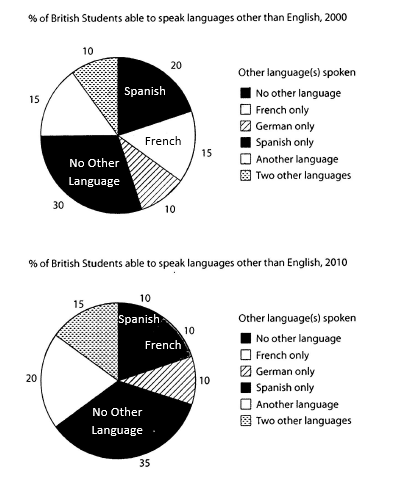
The charts below show the proportions of British students at one university in England who were able to speak other languages in addition to English, in 2000 and 2010
Summarise the information by selecting and reporting the main features, and make comparisons where relevant.
Student answer (Band 6.0)
The pie charts give the percentages of British students that can speak other languages in addition to English at one university in England , For the years of 2000 and 2010.
Overall, pupils who can't talk in another language remained at the first place for the two years.Spanish was the second most speaked language in 2000, even through it has been overtaken by other languages.
The proportion of English speakers only, another language and two other languages all saw a raise. No other language talkers went from 30% of the students of the university to 35% remaining at the top spot.As for another language or two other languages percentages, its went from 15% to 20% and from 10% to 15% respectfully.
The German speakers were the only part that remained with out a change for the two years, as 10% of learners in that university spoke German. By contraxt, Spanish and French speakers saw a decline in their proportion. Spanish speakers went from 20% of students to 10% in 2010, the same rate as French speakrs in that year, despite being 15% in 2000.
AI examiner evaluation
| Criterion | Band |
|---|---|
| Task Achievement / Task Response | 6.5 |
| Coherence and Cohesion | 6.5 |
| Lexical Resource | 5.5 |
| Grammatical Range and Accuracy | 5.5 |
| Overall | 6.0 |
Task Achievement / Task Response: Band 6.5
You identify the main pattern accurately: students speaking no other language remained the largest group, rising from 30% to 35%, while Spanish and French declined and German stayed at 10%. The overview also notes that Spanish was overtaken by the broader “other language” category, and the body includes relevant figures for the main changes. This gives the response a clear, relevant account of both charts. However, “English speakers only” is not a chart category; the data refer to students who speak no other language, so this wording risks confusing the meaning. Some comparisons could also be made more explicit, particularly the shift in ranking between Spanish and “another language.” More precise category labels and a sharper comparison would make the coverage more complete.
Coherence and Cohesion: Band 6.5
The response is arranged in a sensible sequence: an introduction, an overview, and two paragraphs grouping increases and stable or declining categories. This makes the main information easy to follow, and linking phrases such as “Overall,” “As for,” and “By contrast” help signal relationships. The progression is generally clear, though some connections are awkward or unclear. For example, “Spanish was the second most speaked language… even through it has been overtaken by other languages” does not clearly identify which category overtook it, and “The proportion of English speakers only” disrupts the otherwise consistent category references. Punctuation and spacing around sentence boundaries also need attention. Use chart labels consistently and make each comparison’s subject explicit to strengthen cohesion.
Lexical Resource: Band 5.5
You use a reasonable range of language for describing change, including “remained,” “overtaken,” “raise,” “decline,” and “proportion.” These choices show an attempt to vary vocabulary rather than repeat basic terms. However, several word choices and collocations are inaccurate or informal for an academic report: “pupils,” “talkers,” “most speaked,” “saw a raise,” and “the same rate” are not natural descriptions of these data. There are also spelling errors such as “speakrs” and “by contraxt,” and “respectfully” is used where “respectively” is intended. Prefer precise chart language such as “students,” “share,” “increased,” and “fell,” and check spelling and word forms carefully.
Grammatical Range and Accuracy: Band 5.5
You attempt a mix of simple and more complex sentences, including a relative clause in “students that can speak other languages” and a contrast clause beginning “despite being 15% in 2000.” Most of the intended comparisons remain understandable. However, grammatical control is uneven, with errors in sentence boundaries, agreement, and clause construction. The opening sentence is punctuated as a fragment-like statement and has an unnecessary comma before “For the years”; “its went from” has incorrect pronoun and verb agreement; and “Spanish was the second most speaked language… even through it has been overtaken” combines an incorrect form with an unclear tense relationship. There are also missing spaces after full stops. Review sentence boundaries and check subject–verb agreement and verb forms when describing past data.
See this exact question answered at other band scores. The same prompt compared across bands.
Browse more IELTS Writing model answers or get your own writing scored by the same AI examiner.