Band 6.0 IELTS Writing Task 1 Model Answer
Overall Band Score: 6.0 · Cambridge IELTS 11 · 2026-11-24
IELTS Writing Task 1 question
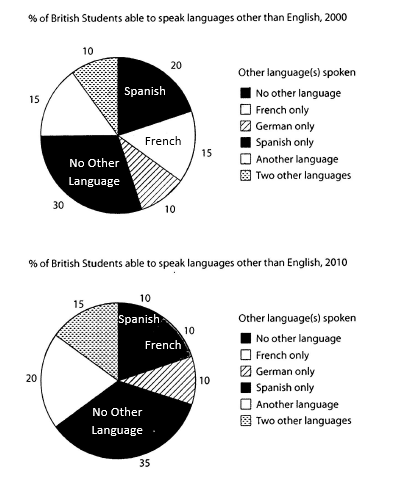
The charts below show the proportions of British students at one university in England who were able to speak other languages in addition to English, in 2000 and 2010
Summarise the information by selecting and reporting the main features, and make comparisons where relevant.
Student answer (Band 6.0)
The given pie charts illustrate the percentage of students at a university in England who can speak other languages in addition to English, between 2000 and 2010.
Overall, it can be noticed that the figures for people who speak no other language were the highest in both charts. It can also be seen that all categories were increased significantly, while the ratio of Spanish speakers decreased and meanwhile, German speakers remained constant.
Firstly, people who speak no other language and only another language were around 15% and 30% in 2000, and increased to 35% and 20% in the next decade. Moreover, people who could speak the other two languages along with English were at 10% in the first year and drastically reduced to 15% in the next year.
Furthermore, people who spoke only French and German were at about 20% and 15% in 2000, and significantly decreased by about 10% in both cases, respectively. Whereas, speakers of Spanish were 20% and declined to 10% in 2010.
AI examiner evaluation
| Criterion | Band |
|---|---|
| Task Achievement / Task Response | 5.5 |
| Coherence and Cohesion | 6.0 |
| Lexical Resource | 6.0 |
| Grammatical Range and Accuracy | 6.0 |
| Overall | 6.0 |
Task Achievement / Task Response: Band 5.5
You identify the main overall pattern that students speaking no other language formed the largest group in both years, and you report several relevant changes, including Spanish falling from 20% to 10% and German remaining at 10%. However, some figures are misassigned: in 2000, no other language was 30% and another language was 15%, not the reverse as stated. French was 15% in 2000, while German was 10%, so the comparison that gives them as 20% and 15% is inaccurate. The overview also says all categories increased, although Spanish and French decreased and German was unchanged. These inaccuracies and the limited development of the key comparisons make the summary only partly effective. Check each figure against the chart and distinguish increases, decreases and stable categories clearly.
Coherence and Cohesion: Band 6.0
The response has a clear overall arrangement: an introduction, an overview, and two paragraphs presenting details. This makes the information easy to follow, and sequencing expressions such as “Firstly” and “Furthermore” help signal movement between groups. However, the progression is sometimes weakened by unclear references, particularly “the other two languages,” which could mean two additional languages rather than the chart category “two other languages.” The contrast beginning “Whereas” is also left as a fragment rather than being integrated into a complete sentence. In addition, the overview’s claim that all categories increased conflicts with the later details. Grouping the categories more consistently and using precise references would make the progression more reliable and the links between ideas less mechanical.
Lexical Resource: Band 6.0
You use an adequate range of vocabulary for describing charts, including “percentage,” “remained constant,” “declined,” and “increased.” These choices generally communicate the intended trends. Some wording is imprecise or repetitive, however: “people” is used for the student groups, and “the other two languages along with English” does not clearly name the chart category. “Drastically reduced” is also an unsuitable description of a rise from 10% to 15%, while “significantly” is repeated without showing the size of the change. Aim for accurate chart language and natural collocations, such as “the proportion of students” and “rose by five percentage points.” This would improve precision while retaining the clear, accessible vocabulary already present.
Grammatical Range and Accuracy: Band 6.0
You use a mix of simple and more complex sentence forms, including clauses introduced by “while” and “who,” and most of the meaning remains clear. Some grammatical errors and awkward constructions remain. For example, “all categories were increased” uses an unnecessary passive form; “all categories increased” is appropriate. “People who could speak the other two languages” is structurally unclear, and “Whereas, speakers of Spanish…” is an incomplete dependent clause. The phrase “increased to 35% and 20% in the next decade” also needs clearer parallel structure to show which figure belongs to each group. Practise forming complete contrast sentences and checking verb forms and clause structure; this will make your varied sentences more controlled.
See this exact question answered at other band scores. The same prompt compared across bands.
Browse more IELTS Writing model answers or get your own writing scored by the same AI examiner.