Band 6.0 IELTS Writing Task 1 Model Answer
Overall Band Score: 6.0 · Cambridge IELTS 11 · 2026-11-24
IELTS Writing Task 1 question
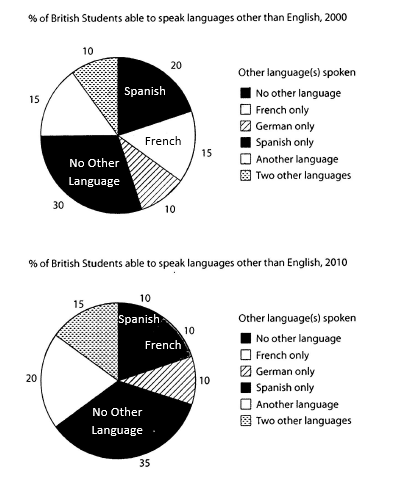
The charts below show the proportions of British students at one university in England who were able to speak other languages in addition to English, in 2000 and 2010
Summarise the information by selecting and reporting the main features, and make comparisons where relevant.
Student answer (Band 6.0)
The pie charts illustrate the percentages of British students speaking other languages than English at one university in England in 2000 and 2010.
At a glance, it is clear that the highest number of students speak no other language whereas a small ratio of them speak other languages including Spanish, French, German and two other languages.
By the end of the millennium, 30% of students showed that they speak no other language. In contrast, 10% of them say German and two other language. French and another language accounted for 15%, while one-fifth of students speak Spanish.
After a decade, no other language remained in the top with a slight increase and reached at 35%. By contrast, German remained in the last with 10% however, Spanish and French students showed a decline in their figure and accounted for both 10%. Both another language and two other languages category increased a little and both climbed at 20% and 15%
AI examiner evaluation
| Criterion | Band |
|---|---|
| Task Achievement / Task Response | 6.0 |
| Coherence and Cohesion | 6.5 |
| Lexical Resource | 6.0 |
| Grammatical Range and Accuracy | 5.5 |
| Overall | 6.0 |
Task Achievement / Task Response: Band 6.0
You identify the main overall pattern: students reporting no other language formed the largest group in both years, while Spanish declined and the “another language” and “two other languages” groups increased. Most figures are accurate, including 30% and 35% for no other language and the 2010 values of 20% and 15% for the two increasing categories. However, the overview is imprecise in calling the other groups “a small ratio,” and the account does not clearly compare the overall distribution across the two years. The statement that German was “in the last” is also misleading: it was tied with two other languages in 2000 and tied with French in 2010. A more explicit overview and clearer comparisons would make the key features more fully developed.
Coherence and Cohesion: Band 6.5
The response has a clear four-part structure: an introduction, an overview, and separate descriptions of 2000 and 2010. This gives the reader a generally logical progression, and transitions such as “In contrast,” “After a decade,” and “By contrast” help signal comparisons. This is already a strength. Some links are less effective, however: “German remained in the last with 10% however” combines contrasting ideas without suitable punctuation or a clear connection, and the final sentence ends without a full stop. The year-by-year approach also means that direct comparisons between categories are limited. To strengthen progression further, group the most important changes together and use referencing and punctuation consistently.
Lexical Resource: Band 6.0
You use an adequate range of task-related vocabulary, including “accounted for,” “remained,” “decline,” and “climbed,” which helps describe proportions and changes. The meaning is generally clear, but some choices are imprecise or unnatural for chart reporting. “The highest number” refers to a count rather than a proportion, while “a small ratio” is not the most suitable expression here. “German remained in the last” is also an unclear way to describe its ranking. There is some repetition of “other language(s)” and “students,” and “showed that they speak” is wordier than necessary. More precise collocations for proportions and rankings would improve clarity and control.
Grammatical Range and Accuracy: Band 5.5
You use both simple and more complex sentence forms, including the contrastive construction “whereas a small ratio…” and the sentence comparing the two rising categories. Most of the information remains understandable, but some grammatical errors and punctuation problems are present. In “10% of them say German and two other language,” the verb form and singular noun do not fit the past-time description; “accounted for both 10%” also has an awkward structure. The sentence beginning “German remained in the last” needs clearer punctuation around “however,” and the final sentence needs a full stop. Aim to keep tense consistent when reporting past data, check singular and plural forms, and divide long comparisons into well-punctuated clauses.
See this exact question answered at other band scores. The same prompt compared across bands.
Browse more IELTS Writing model answers or get your own writing scored by the same AI examiner.