Band 5.0 IELTS Writing Task 1 Model Answer
Overall Band Score: 5.0 · Cambridge IELTS 11 · 2026-11-25
IELTS Writing Task 1 question
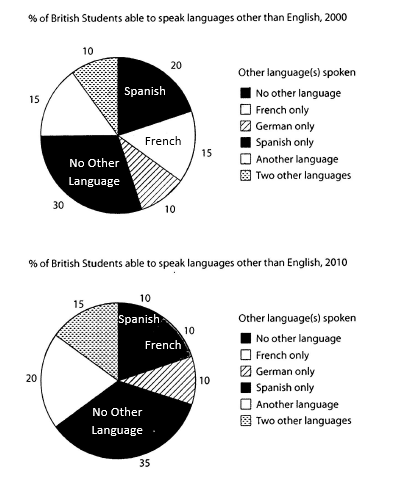
The charts below show the proportions of British students at one university in England who were able to speak other languages in addition to English, in 2000 and 2010
Summarise the information by selecting and reporting the main features, and make comparisons where relevant.
Student answer (Band 5.0)
The chart gives information of students of British and England University who spoken English and other languages. Overall, the Spanish language was spoken more in 2000, but it reduced to 10 percent in 2010. Subsequently, the two other languages were spoken 10 percent in 2000 while it rose dramatically to 15 percent. As well as the individuals who were able to speak another language was 15 percent in contrast to 20 percent in 2010. The ratio of speaking the German language remained same from 2000 to 2010. Finally, no other language was also increased to 30 to 35 percent in 2010. Although it was 30 percent in 2000.
AI examiner evaluation
| Criterion | Band |
|---|---|
| Task Achievement / Task Response | 5.0 |
| Coherence and Cohesion | 5.0 |
| Lexical Resource | 5.5 |
| Grammatical Range and Accuracy | 5.0 |
| Overall | 5.0 |
Task Achievement / Task Response: Band 5.0
You identify several relevant changes, including Spanish falling from 20% to 10%, the share speaking two other languages rising from 10% to 15%, and German remaining at 10%. However, the response only partially covers the charts: it omits the French figures and does not clearly compare the categories as a whole. The overview is also weakened by the unclear opening, which suggests students “spoken English and other languages,” rather than stating that the charts show additional languages spoken. The final point repeats the no-other-language figure rather than adding a distinct feature. The response is 108 words, below the required 150, so there is limited space to select and explain the main features. Develop a concise overview and include the key comparisons.
Coherence and Cohesion: Band 5.0
The response follows a broadly chronological pattern, moving through changes from 2000 to 2010, and uses linking expressions such as “Overall,” “Subsequently,” and “Finally.” This gives the reader some sense of sequence. However, the ideas are presented as one continuous paragraph, with no clear separation between an overview and supporting details. Some links are awkward or repetitive: “Finally” is followed by “Although,” which leaves the last thought as a fragment, while “As well as” does not clearly connect the point about another language to the preceding comparison. Organise the response into an introduction, an overview, and grouped comparisons, and use connectors only where they show a clear relationship.
Lexical Resource: Band 5.5
You use some relevant chart vocabulary, including “percent,” “remained,” “increased,” and “reduced,” so the main trends can generally be understood. There is also an attempt to vary expressions, for example “rose dramatically.” However, several choices are unnatural or imprecise for describing the data: “gives information of” and “spoken more” do not express the chart’s meaning clearly, and “the ratio of speaking the German language” is an awkward collocation. “Dramatically” also overstates a rise of five percentage points. Aim for accurate, conventional phrases such as “the proportion of students who spoke” and “increased slightly,” and use “share” or “percentage” consistently when comparing categories.
Grammatical Range and Accuracy: Band 5.0
The response attempts a few different sentence patterns, including a contrast with “while” and a clause beginning “Although.” However, the range is limited, and errors in verb forms and sentence construction occur repeatedly. For example, “who spoken English” needs a finite verb form, while “the two other languages were spoken 10 percent” does not form a correct comparison. The final “Although it was 30 percent in 2000” is a dependent clause standing alone, and “it reduced” has an unclear reference. These problems sometimes make relationships between the figures difficult to follow. Practise complete comparative sentences, checking subject–verb structure and ensuring that each subordinate clause is attached to a main clause.
See this exact question answered at other band scores. The same prompt compared across bands.
Browse more IELTS Writing model answers or get your own writing scored by the same AI examiner.