Band 4.0 IELTS Writing Task 1 Model Answer
Overall Band Score: 4.0 · Cambridge IELTS 11 · 2026-11-25
IELTS Writing Task 1 question
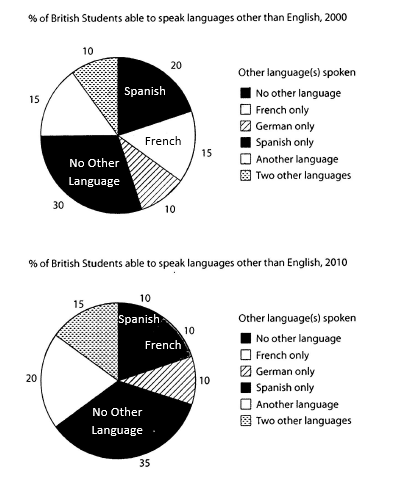
The charts below show the proportions of British students at one university in England who were able to speak other languages in addition to English, in 2000 and 2010
Summarise the information by selecting and reporting the main features, and make comparisons where relevant.
Student answer (Band 4.0)
the charts represent that the percentage of universiity students who were able to speak other language and english in 2000 and 2012.
overall, students who speak english were higher then the other languages in both year. furthermore spanish and french speakers declined while, german speakers and another language increased. people who speak two other languages remained same.
in 2000,
AI examiner evaluation
| Criterion | Band |
|---|---|
| Task Achievement / Task Response | 3.0 |
| Coherence and Cohesion | 4.0 |
| Lexical Resource | 4.5 |
| Grammatical Range and Accuracy | 4.5 |
| Overall | 4.0 |
Task Achievement / Task Response: Band 3.0
You identify the general topic and attempt an overview, noting that Spanish and French declined and that the share speaking another language increased. However, the response does not accurately report the chart’s main comparisons: it says English speakers were the largest group, although the charts show students speaking no other language, and it claims the two-language group stayed the same when it rose from 10% to 15%. German remained at 10%, rather than increasing. The year is also given as 2012 instead of 2010. Most importantly, the response stops before describing the 2000 figures or providing a meaningful account of both charts, and it is well below the required 150 words. Select the largest categories and key changes, then support the overview with accurate figures.
Coherence and Cohesion: Band 4.0
There is a basic attempt to organise the response: an opening sentence is followed by an overview introduced with “overall,” and the ideas are presented in a broadly understandable order. However, the final fragment, “in 2000,” leaves the report unfinished, so there is no developed comparison or clear progression through the data. The overview also places several claims together without explaining how they relate, and the transition “furthermore” does not make the contrast between declining and increasing categories especially clear. Use a complete introduction, a concise overview, and one or two body paragraphs grouped by the most important comparisons. Linking expressions should clarify relationships rather than simply announce another point.
Lexical Resource: Band 4.5
The response uses a small set of relevant terms, including “percentage,” “speakers,” “declined,” and “increased,” which lets the reader recognise the general subject and some trends. However, the vocabulary is limited and several expressions are imprecise for describing these charts. “Students who speak English” misidentifies the category, while “other language” and “people who speak two other languages” are awkward or insufficiently specific. There are also spelling and word-form problems, such as “universiity” and “languages” where the singular is needed in “other language.” Build a more accurate range around chart language such as “the proportion of students,” “no other language,” and “the share speaking two additional languages.”
Grammatical Range and Accuracy: Band 4.5
You attempt both a simple opening statement and a longer overview sentence, and the main ideas can generally be understood. However, grammatical control is uneven. In “the percentage of universiity students who were able to speak other language and english,” the article and number pattern is faulty; “in 2000 and 2012” also gives an incorrect year, though that is a factual rather than grammatical issue. The comparison “students who speak english were higher then the other languages” has an unclear structure, and “in both year” lacks plural agreement. Capitalisation and punctuation are inconsistent, and the unfinished “in 2000,” is not a complete sentence. Practise accurate comparative clauses and complete sentences before adding more complex structures.
See this exact question answered at other band scores. The same prompt compared across bands.
Browse more IELTS Writing model answers or get your own writing scored by the same AI examiner.