Band 6.0 IELTS Writing Task 1 Model Answer
Overall Band Score: 6.0 · Cambridge IELTS 11 · 2026-11-26
IELTS Writing Task 1 question
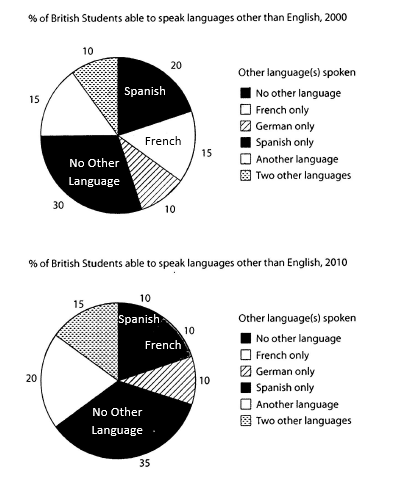
The charts below show the proportions of British students at one university in England who were able to speak other languages in addition to English, in 2000 and 2010
Summarise the information by selecting and reporting the main features, and make comparisons where relevant.
Student answer (Band 6.0)
The two pie charts compare the percentage of British students able to speak languages other than english at one university in England over a 10 year period from 2000 to 2010.
Overall, it can be clearly seen that in both years,no other language beside English,accounted for the highest spoken languages whereas, other languages were least spoken compare to english.
In 2000, nearly third 30% of pupils spoke only English, followed by Spanish at 20%. French only and another language recorded only 15%, while both German only and two other languages were the least spoken languages at 10%.
In 2010, still english language stood at the most spoken languages, rose by 5% compared to 2000 to 35%. Another language at 20%, followed by two other languages at 15%. Spanish, French and German were not commonly spoken language at 10%. Half of the students declined in Spanish compared to 2000. Except English other all languages decreased in 2010.
AI examiner evaluation
| Criterion | Band |
|---|---|
| Task Achievement / Task Response | 5.5 |
| Coherence and Cohesion | 6.5 |
| Lexical Resource | 5.5 |
| Grammatical Range and Accuracy | 5.5 |
| Overall | 6.0 |
Task Achievement / Task Response: Band 5.5
You identify the main overall feature—that the “No Other Language” group was largest in both years—and report several accurate figures, including its rise from 30% to 35% and the fall in Spanish from 20% to 10%. However, the overview is unclear when it says “other languages were least spoken,” since the smallest categories differ by year and several categories share the lowest value. The final claim that “Except English other all languages decreased” is inaccurate: “Another language” rose from 15% to 20%, and “Two other languages” rose from 10% to 15%. The response covers both charts, but the overview and comparisons are not consistently precise, and some key changes are misreported or insufficiently explained.
Coherence and Cohesion: Band 6.5
The response has a clear overall arrangement: an introduction, an overview, and separate paragraphs for 2000 and 2010. This makes the information easy to follow, and sequencing expressions such as “In 2000” and “In 2010” help orient the reader. The organisation is coherent, though some links between ideas are awkward or unclear. For example, “whereas” in the overview does not establish a clear contrast, and “Except English other all languages decreased” is difficult to connect to the preceding figures. The 2010 paragraph would progress more logically if it grouped categories that rose, fell, or stayed unchanged. More precise linking and clearer references would strengthen the flow.
Lexical Resource: Band 5.5
You use relevant chart vocabulary, including “percentage,” “followed by,” “recorded,” and “compared to,” so the meaning is generally understandable. However, the range is somewhat limited, and several word choices or collocations are inaccurate or unnatural. “Highest spoken languages” does not clearly describe the largest category, while “least spoken languages” is awkward for these proportions. “Nearly third 30%” is also an unclear expression, and “Half of the students declined in Spanish” incorrectly suggests that students themselves declined. Repeated use of “spoken” and “language” further limits flexibility. Choose precise terms such as “accounted for,” “share,” “category,” and “fell by half” to describe the data more naturally.
Grammatical Range and Accuracy: Band 5.5
You attempt a mix of simple statements and more developed comparisons, and the reader can usually understand the intended meaning. However, grammatical control is inconsistent, particularly in sentence construction, agreement, and punctuation. In “in both years,no other language beside English,accounted,” the commas interrupt the sentence and the subject–verb structure is unclear. “English language stood at the most spoken languages” has a mismatch between singular and plural, while “Spanish, French and German were not commonly spoken language” also needs plural agreement. The final sentence, “Except English other all languages decreased,” has an incomplete grammatical structure. Work on accurate sentence patterns and punctuation, especially when comparing categories, while continuing to practise complex forms.
See this exact question answered at other band scores. The same prompt compared across bands.
Browse more IELTS Writing model answers or get your own writing scored by the same AI examiner.