Band 4.0 IELTS Writing Task 1 Model Answer
Overall Band Score: 4.0 · Cambridge IELTS 11 · 2026-11-26
IELTS Writing Task 1 question
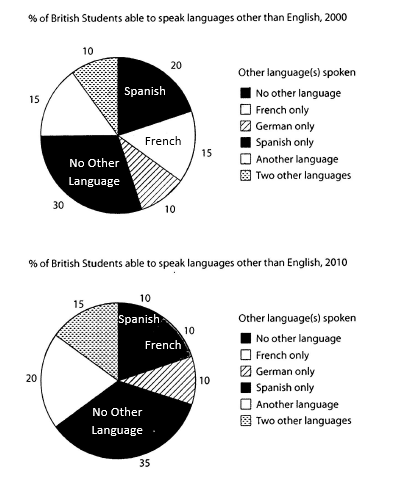
The charts below show the proportions of British students at one university in England who were able to speak other languages in addition to English, in 2000 and 2010
Summarise the information by selecting and reporting the main features, and make comparisons where relevant.
Student answer (Band 4.0)
The charts illustrate the percentages of British pupils at one institution in England who were capable to speak different languages furthermore to English during 2000 to 2010.
Overall,the most spoken languages were Spanish,French and English in 2000 . while, In 2010 spanish , french and english were most spoken language of british students. Furthermore , no other languages and Spanish and French mostly spoken languages of British students and In contrast , German and Two other languages afterwards spoken languages in 2000 .
On the
other hand , the mostly used language was the no other language mean english language and afterwards , the French and and Spanish were highest spoken languages England while German comes which used as a very low number
AI examiner evaluation
| Criterion | Band |
|---|---|
| Task Achievement / Task Response | 3.5 |
| Coherence and Cohesion | 3.5 |
| Lexical Resource | 5.0 |
| Grammatical Range and Accuracy | 4.5 |
| Overall | 4.0 |
Task Achievement / Task Response: Band 3.5
You identify the topic and make a general attempt to compare the two years, but the response reports very little of the chart accurately. It incorrectly says English was among the most spoken languages; the chart instead shows the proportion speaking no other language, not English as a separate spoken-language category. It also claims French and Spanish were the highest in 2010, although “no other language” was the largest category at 35%, followed by another language at 20%. The key changes—Spanish falling from 20% to 10%, and the no-other-language, another-language and two-other-languages groups rising—are not clearly reported. The response is also 27 words below the required minimum. To improve, give a precise overview and support it with the main figures and comparisons.
Coherence and Cohesion: Band 3.5
There is a basic attempt to organise the response, beginning with an introduction and then using “Overall” and “On the other hand” to signal further points. However, the ideas do not develop in a clear sequence: the overview repeats language rankings, then the final section introduces another comparison without explaining how it relates to the earlier statements. The unfinished phrase “On the / other hand” and the long gaps and irregular spacing also interrupt the flow. Some linking expressions are used inaccurately or mechanically, and references such as “afterwards” do not make the time comparison clear. Use separate, purposeful paragraphs for the overview and key comparisons, and connect each figure directly to the relevant year.
Lexical Resource: Band 5.0
The response uses some task-related vocabulary, including “percentages,” “spoken languages,” and “in contrast,” so the topic is generally recognisable. However, the range is limited and several word combinations are unnatural or imprecise, such as “capable to speak,” “mostly used language,” and “highest spoken languages.” Repetition of “spoken languages” and “British students” also limits flexibility, while “afterwards spoken languages” is difficult to interpret. These choices sometimes obscure the intended comparison. Build a more accurate range for describing chart categories and change, such as “accounted for,” “the largest proportion,” “increased,” and “declined,” and check spelling and capitalisation of language names.
Grammatical Range and Accuracy: Band 4.5
You attempt to form longer sentences and use contrast clauses, for example, “Furthermore…” and “On the other hand…,” but control is inconsistent. Sentence boundaries and punctuation are often faulty: “Overall,the most spoken languages…” runs into a sentence fragment beginning “while,” and the final sentence lacks a clear grammatical structure. There are also errors in verb patterns and agreement, including “were most spoken language” and “German comes which used.” Articles, prepositions and spacing around punctuation are not controlled consistently. These problems make several relationships between ideas hard to follow. Practise writing complete, clearly punctuated sentences with a consistent past-time frame, and check subject–verb agreement and verb forms.
See this exact question answered at other band scores. The same prompt compared across bands.
Browse more IELTS Writing model answers or get your own writing scored by the same AI examiner.