Band 5.0 IELTS Writing Task 1 Model Answer
Overall Band Score: 5.0 · Cambridge IELTS 11 · 2026-11-26
IELTS Writing Task 1 question
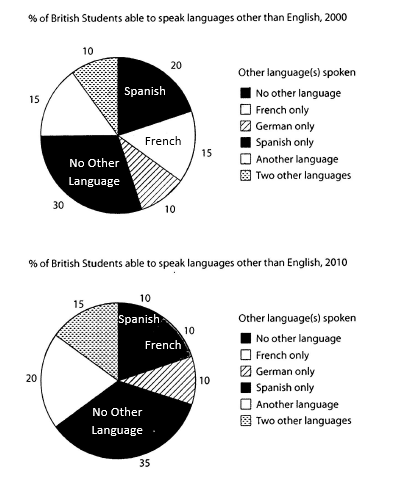
The charts below show the proportions of British students at one university in England who were able to speak other languages in addition to English, in 2000 and 2010
Summarise the information by selecting and reporting the main features, and make comparisons where relevant.
Student answer (Band 5.0)
This chart gives information about the people who were able to speak different languages. Overall, there is a minor change in the no other language meanwhile, the other languages were almost same. Firstly, the Spanish language is reduce to 10 percent in 2010, it was 20 percent in 2000, but it became half in 2010. Subsequently, the another language was rose to 15 percent to 20 percent, it was 15 percent in 2010 while, 20 percent in 2010. However, the German language remained the same in both years. The individuals who were able to speak the German language were not changed. The two other languages were also increased to 5 percent in 2010, the ratio of speaking the tow other languages was 10 percent in 2000, but it increased in 2010. Finally, no other language was 30 percent in 2000, but it increased to 5 percent and it was 35 percent in 2010.
AI examiner evaluation
| Criterion | Band |
|---|---|
| Task Achievement / Task Response | 4.5 |
| Coherence and Cohesion | 4.5 |
| Lexical Resource | 5.0 |
| Grammatical Range and Accuracy | 5.0 |
| Overall | 5.0 |
Task Achievement / Task Response: Band 4.5
You identify several relevant features, including the fall in Spanish, the unchanged German figure, and increases in “another language,” two other languages, and no other language. However, the overview is unclear and partly inaccurate: saying “the other languages were almost same” overlooks the notable shifts, especially the rise in students with no other language and the decline in Spanish. The French figures are omitted, and the account of “another language” is contradictory: it gives 15% and 20% for 2010. Some comparisons are also repeated rather than clearly reported. To strengthen the response, give a concise overview of the main changes, then report the correct figures consistently for the key categories.
Coherence and Cohesion: Band 4.5
The response follows a basic sequence, using “Overall,” “Firstly,” “Subsequently,” “However,” and “Finally” to introduce points. This gives the reader some sense of order, and the categories are generally discussed one after another. However, the progression is not consistently clear: “the another language was rose to 15 percent to 20 percent” is difficult to follow, and the next clause repeats the figures with conflicting years. The German point is stated twice in succession, while French is not integrated into the account. Organise the response into a clear overview followed by grouped comparisons, and use linking words only where they accurately show the relationship between ideas.
Lexical Resource: Band 5.0
You use a basic range of task-related vocabulary, including “remained the same,” “increased,” “ratio,” and “percent,” so the general subject is understandable. However, several word choices and collocations are inaccurate or repetitive, such as “the other languages were almost same,” “the another language,” and “the ratio of speaking.” “Individuals” is also less natural here than “students,” and “different languages” is vague when describing the chart categories. These limitations make some comparisons harder to interpret. Aim for precise chart language such as “the proportion of students speaking…” and vary verbs like “rose,” “fell,” and “remained stable,” while checking that each phrase fits its grammatical context.
Grammatical Range and Accuracy: Band 5.0
You attempt some longer sentences with contrast and time references, for example, “The German language remained the same in both years” and the comparison beginning “Firstly.” These show an effort to connect information, but control is inconsistent. Errors include “Spanish language is reduce,” “the another language was rose,” and “the two other languages were also increased,” where verb forms and sentence patterns are faulty. The sentence about “another language” also has unclear clause structure, and punctuation around “while” does not help the meaning. Use straightforward comparative structures accurately—for example, “Spanish fell from 20% in 2000 to 10% in 2010”—before attempting more complex combinations.
See this exact question answered at other band scores. The same prompt compared across bands.
Browse more IELTS Writing model answers or get your own writing scored by the same AI examiner.