Band 4.5 IELTS Writing Task 1 Model Answer
Overall Band Score: 4.5 · Cambridge IELTS 11 · 2026-11-26
IELTS Writing Task 1 question
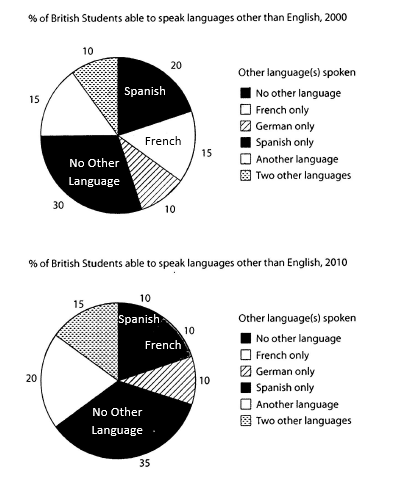
The charts below show the proportions of British students at one university in England who were able to speak other languages in addition to English, in 2000 and 2010
Summarise the information by selecting and reporting the main features, and make comparisons where relevant.
Student answer (Band 4.5)
The bar chart shows, the proportions of British students at one university in England who were able to speak other languages in addition to English, in 2000 and 2010
Over all,foreign student percentage increase by time in British university of England.And all the new languages get popular by time in England.
In 2000,the number of british Students who can speak other languages amoung English that are;Spanish spoken by 20% of population,French 15%,German 10%,Another language 15%,Two other language 10% and no other language 30%.
Now in 2010,% of british Stundents able to speak languages other then English are.Spanish and French spoken by 10% of population,German 15% only,Another language 20%,Two other language 15% and no other language 35%.
AI examiner evaluation
| Criterion | Band |
|---|---|
| Task Achievement / Task Response | 4.0 |
| Coherence and Cohesion | 5.0 |
| Lexical Resource | 5.0 |
| Grammatical Range and Accuracy | 4.5 |
| Overall | 4.5 |
Task Achievement / Task Response: Band 4.0
The response identifies the two years and reports several chart categories, but it does not provide a clear, accurate overview of the main changes. The claim that “all the new languages get popular” is too broad: Spanish and French both declined, while German stayed at 10%. There is also a key data error: German is reported as 15% in 2010, although the chart shows 10%. The response contains only 91 words, below the required 150, and this limits the detail and comparisons provided. To improve, give a concise overview of the largest shifts, then compare the figures accurately, including the rise in “no other language” from 30% to 35% and the fall in Spanish from 20% to 10%.
Coherence and Cohesion: Band 5.0
The information is presented in a basic sequence: an opening, a general statement, and separate descriptions of 2000 and 2010. This gives the reader some organisation, and the year-based grouping is a useful starting point. However, progression is limited because the overview is vague and the figures are mostly listed rather than compared. The transition “Now in 2010” is understandable but informal, while punctuation and spacing make the divisions between ideas less clear. For example, the opening sentence ends without a full stop, and “Over all,foreign” runs together. Use clear paragraphs and linking phrases such as “By contrast” or “Meanwhile” to connect the most important changes, rather than relying on a list of categories.
Lexical Resource: Band 5.0
The response uses enough basic vocabulary to identify the chart topic and categories, including “proportions,” “population,” and “another language.” However, the range is limited and several choices are inaccurate or unnatural, which makes some statements unclear. “Foreign student percentage” does not accurately describe the chart, which concerns British students who speak additional languages, and “new languages get popular” is not a precise description of changing proportions. There are also spelling and form errors, including “Stundents,” “amoung,” and “other then.” Use precise chart language such as “the proportion of students,” “accounted for,” and “rose/fell/remained unchanged,” and check spelling and capitalisation of language names.
Grammatical Range and Accuracy: Band 4.5
Most sentences use simple structures, and the reader can generally recognise the intended comparison. However, grammatical control is weak and errors frequently affect clarity. The opening has an unnecessary comma after “shows” and lacks a final full stop. The overview, “foreign student percentage increase by time,” has problems with articles, agreement, and sentence construction. In the data sentences, “Spanish spoken by 20%” needs a complete grammatical structure, while “Two other language” requires a plural form. The response also shifts awkwardly between “can speak” and “able to speak.” Practise complete sentences with a clear subject and verb, for example, “The proportion speaking Spanish fell from 20% to 10%.” Use consistent tense and check articles, plurals, and punctuation.
See this exact question answered at other band scores. The same prompt compared across bands.
Browse more IELTS Writing model answers or get your own writing scored by the same AI examiner.