Band 5.5 IELTS Writing Task 1 Model Answer
Overall Band Score: 5.5 · Cambridge IELTS 11 · 2026-11-27
IELTS Writing Task 1 question
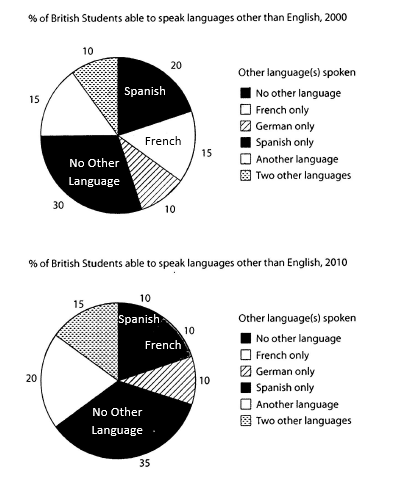
The charts below show the proportions of British students at one university in England who were able to speak other languages in addition to English, in 2000 and 2010
Summarise the information by selecting and reporting the main features, and make comparisons where relevant.
Student answer (Band 5.5)
the pie chart shows the in formation about the the proportions of British students at one university in England who were able to speak other languages in addition to English, in 2000 and 2010.
To begian with,there are 10% British students who able to speak Sepanish langauage other then english in 2010 and 20% in 2000. No other langauage spoken by british students are 30% in 2000 and it increase from 30 to 35% in 2010. As german was spoken by only 10% in both years by british students . Two other languages spoken by british students had a diffirence of 5% in 2000 it was 10 and in 2010 15%.
Futher more, french was spoken by 15% in 2000 , But in 2010 it was only spoken by 10% which had a difference of 5% dicline. 15% of another language was spoken by british students in 2000 and it increase 5% in 2010
overall, the no other language students are maximum and german was spoken by same precent of students in both yearswhich was minimum.
AI examiner evaluation
| Criterion | Band |
|---|---|
| Task Achievement / Task Response | 6.0 |
| Coherence and Cohesion | 5.5 |
| Lexical Resource | 5.0 |
| Grammatical Range and Accuracy | 5.0 |
| Overall | 5.5 |
Task Achievement / Task Response: Band 6.0
You report the main categories and make several accurate comparisons: Spanish falls from 20% to 10%, French from 15% to 10%, while “another language” rises from 15% to 20%; German remains at 10%. You also identify that having no other language is the largest category in both years, increasing from 30% to 35%. This covers the key information and gives a relevant overall statement. However, the overview is not fully precise: German is not the minimum in 2010, since Spanish and French are also at 10%. Some comparisons are presented as separate facts rather than being clearly synthesised, and the opening repeats the task wording. A more exact overview and clearer grouping of the main changes would strengthen the report.
Coherence and Cohesion: Band 5.5
The response has a basic overall structure: an introduction, a paragraph reporting several figures, a further paragraph covering French and another language, and a concluding overview. This makes the information reasonably easy to locate. However, progression between points is sometimes mechanical, with “To begian with” and “Futher more” used to introduce lists rather than show meaningful relationships. The final “overall” statement arrives after the details and repeats information without resolving the inaccurate claim about the minimum category. Some sentences also combine several comparisons without clear punctuation, making the links between ideas less smooth. Grouping the categories that increased together and those that decreased or stayed stable would create a clearer progression.
Lexical Resource: Band 5.0
You use relevant chart vocabulary, including “proportions,” “spoken,” “increase,” “difference,” and “decline,” so the reader can generally understand the comparisons. However, the range is limited and some choices are inaccurate or awkward, such as “No other language spoken by British students” and “had a difference of 5% decline.” Repetition of “spoken by British students” also makes the report less concise. Spelling errors—including “Sepanish,” “langauage,” “begian,” and “Futher”—are noticeable and reduce the accuracy of the vocabulary. Aim for precise reporting phrases such as “accounted for,” “rose to,” and “remained unchanged,” and check spelling carefully.
Grammatical Range and Accuracy: Band 5.0
You attempt both simple statements and longer comparisons, and the main figures can usually be understood. However, sentence structures are often incomplete or inaccurately formed. For example, “there are 10% British students who able to speak” needs a clearer construction, such as “10% of British students were able to speak.” In “it increase from 30 to 35%,” the verb form should be “increased,” and “As german was spoken…” is a dependent clause presented as a sentence fragment. There are also problems with articles, agreement, and punctuation, as in “the no other language students are maximum.” Use complete sentences with consistent past-tense reporting, and separate comparisons with appropriate punctuation.
See this exact question answered at other band scores. The same prompt compared across bands.
Browse more IELTS Writing model answers or get your own writing scored by the same AI examiner.