Band 5.5 IELTS Writing Task 1 Model Answer
Overall Band Score: 5.5 · Cambridge IELTS 11 · 2026-11-27
IELTS Writing Task 1 question
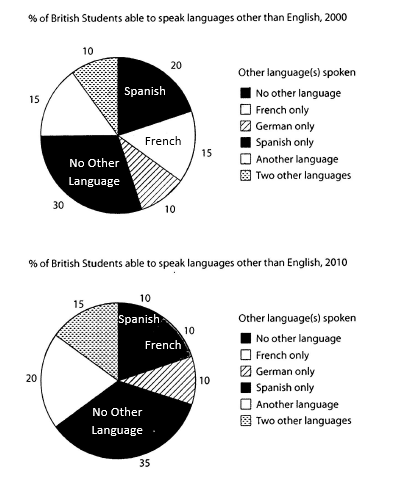
The charts below show the proportions of British students at one university in England who were able to speak other languages in addition to English, in 2000 and 2010
Summarise the information by selecting and reporting the main features, and make comparisons where relevant.
Student answer (Band 5.5)
The given pie charts illustrate the percentage of students able to speak languages other than English in specific university in England in 2000 and 2010.
Overall, it can be seen that the majority of students spoke only English in both years. The second large proportions were spoken Spanish, Frensh and another language in 2000, While in 2010, they were spoken Frensh only and two other languages respectively, other languages remained stable during the given period.
In 2000, large number of the university students prefer to speak in English with 30%. However, Frensh only and another language occupied 15%, German only and two other languages were equally 10%.
In 2010, the category no other language remained the highest proportion at 35%. Students spoken French and two other languages increased slightly to 20% and 15% respectively. while the others: Spanish, French and Germany went down to 10% of the total amount of students.
AI examiner evaluation
| Criterion | Band |
|---|---|
| Task Achievement / Task Response | 6.0 |
| Coherence and Cohesion | 6.0 |
| Lexical Resource | 5.5 |
| Grammatical Range and Accuracy | 5.0 |
| Overall | 5.5 |
Task Achievement / Task Response: Band 6.0
You identify the charts’ subject and give an overview that recognises the largest category in both years and changes in language ability. Several figures are reported accurately, including no other language at 30% in 2000 and 35% in 2010, and German at 10% in both years. However, some comparisons are unclear or inaccurate: Spanish fell from 20% to 10%, but the overview does not clearly highlight this major decline. More importantly, you say French and two other languages increased to 20% and 15%; French actually fell from 15% to 10%, while “another language” rose to 20%. The overview also says some categories remained stable, although only German did. Clearer selection and accurate reporting of the main changes would strengthen the response.
Coherence and Cohesion: Band 6.0
The response has a recognisable four-part structure: introduction, overview, and separate descriptions of the two years. This gives the reader a generally coherent route through the information, and phrases such as “Overall” and “In 2010” help signal the stages. However, the comparisons are not always easy to follow because categories are grouped imprecisely. For example, “the second large proportions were spoken Spanish, Frensh and another language” does not make clear which categories are being compared, and the final sentence lists “Spanish, French and Germany” without a clear link to the earlier figures. Some transitions, including “However,” do not express a meaningful contrast. Grouping categories by increase, decrease, or stability would create clearer progression and more effective cohesion.
Lexical Resource: Band 5.5
You use a reasonable range of chart-related vocabulary, including “percentage,” “proportions,” “category,” and “remained,” so the topic is generally clear. There are also attempts at more formal reporting language, such as “occupied” and “illustrate.” However, several word choices and collocations are inaccurate or unnatural: “the second large proportions were spoken,” “prefer to speak in English,” and “Students spoken French” do not express the intended data clearly. “Germany” is used where the language “German” is meant, and “Frensh” is misspelled more than once. These errors make some comparisons harder to interpret. Aim for precise chart language such as “accounted for,” “the proportion of students,” and “students who spoke French.”
Grammatical Range and Accuracy: Band 5.0
You attempt both simple and more complex sentences, including an overview sentence beginning “Overall” and a contrast introduced by “However.” The main message is usually recoverable, but some grammatical errors affect clarity. For example, “in specific university” is missing an article, while “the second large proportions were spoken” has an incorrect sentence structure. “Students spoken French and two other languages increased” also lacks a suitable verb construction, and the sentence beginning “while the others” is not properly connected or capitalised. There are some tense and agreement problems in descriptions of the data, as in “students prefer to speak.” More consistent sentence patterns, accurate articles and verb forms, and careful punctuation would improve control.
See this exact question answered at other band scores. The same prompt compared across bands.
Browse more IELTS Writing model answers or get your own writing scored by the same AI examiner.