Band 6.0 IELTS Writing Task 1 Model Answer
Overall Band Score: 6.0 · Cambridge IELTS 11 · 2026-11-27
IELTS Writing Task 1 question
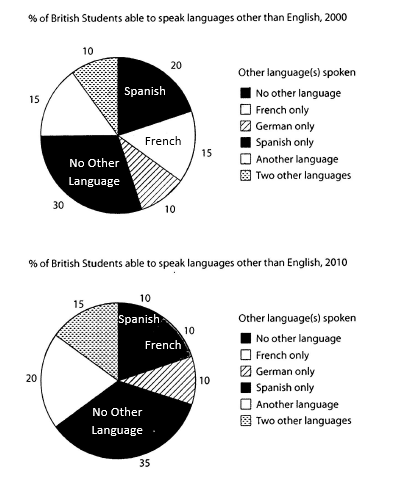
The charts below show the proportions of British students at one university in England who were able to speak other languages in addition to English, in 2000 and 2010
Summarise the information by selecting and reporting the main features, and make comparisons where relevant.
Student answer (Band 6.0)
The given pie charts compare the data of England's university that British students can speak different languages in addition to English during the years 2000 to 2010.
Overall,it can be seen that the most student were unable to speak other language than the English. A significant amount of drop for spanish speakers. In addition, some showed positive response over the years. While, German speaker remained the same.
The populataion of spanish speaker in the year 2010 become half compared with the year 2000 at 20%. French speakers were recorded for 15% in the year 2000. However igures were fall in the year 2010 by 5%. In contrast, 5% of the total population increased for not knowing the any other language in the year 2010 accounted at 35%.
German speakers remained same for at 10%. Another languages were recorded for 15% speakers in the year 2000 and increased to 20% in the year 2010. The numbers for two other languages speakers were recorded for 10% to 15% from the years 2000 to 2010 respectively.
AI examiner evaluation
| Criterion | Band |
|---|---|
| Task Achievement / Task Response | 6.5 |
| Coherence and Cohesion | 6.0 |
| Lexical Resource | 5.5 |
| Grammatical Range and Accuracy | 5.0 |
| Overall | 6.0 |
Task Achievement / Task Response: Band 6.5
You identify the main overall pattern: students speaking no other language formed the largest group in both years, Spanish declined, and German stayed unchanged. The figures you report for the categories are accurate, including the rise in “another language” and “two other languages.” This gives the response a sound factual basis and addresses the key comparisons. To make the overview more complete and precise, state explicitly that the no-other-language group increased from 30% to 35%, and summarise the contrasting movement across the categories rather than relying on the vague phrase “some showed positive response.” Some details are also expressed unclearly, such as “at 20%” when describing Spanish in 2000; clearer comparisons would strengthen the report further.
Coherence and Cohesion: Band 6.0
The response has a recognisable structure: an introduction, an overview, and two paragraphs presenting the figures. The final paragraph groups the unchanged German figure with the increases in the two other categories, which helps the reader follow the data. However, progression within the overview is weakened by the fragment “A significant amount of drop for spanish speakers” and the abrupt “While, German speaker remained the same.” Some linking is also mechanical or unclear, particularly “In contrast” before the rise in students speaking no other language. Use complete sentences and make the relationship between comparisons explicit. A more systematic order—first the largest group and main decline, then the remaining categories—would make the report easier to follow.
Lexical Resource: Band 5.5
You use relevant vocabulary for describing chart data, including “increased,” “remained the same,” “accounted at,” and “recorded.” These choices show an attempt to vary the language rather than repeat basic terms throughout. However, several word combinations are unnatural or imprecise, such as “a significant amount of drop,” “positive response,” and “the population of Spanish speaker.” “Accounted at” is also not the appropriate collocation for a percentage. There are spelling and form errors, including “populataion,” “igures,” and inconsistent capitalisation of “Spanish.” These do not prevent the reader from understanding the main comparisons, but more accurate collocations and consistent spelling would make the description clearer and more natural.
Grammatical Range and Accuracy: Band 5.0
You attempt both simple and more complex sentence forms, including a comparison with “compared with” and a contrast introduced by “However.” The main figures are generally understandable, but grammatical control is uneven. Examples include “the most student were unable,” where the noun and verb do not agree, and “German speakers remained same for at 10%,” which has an incomplete construction. The opening sentence also has an unclear clause structure, while “the year 2010 become half” uses an incorrect verb form and comparison pattern. Punctuation and spacing are inconsistent, and the overview includes sentence fragments. Practise complete subject–verb structures and accurate past-tense comparisons, then proofread articles, plurals, and punctuation.
See this exact question answered at other band scores. The same prompt compared across bands.
Browse more IELTS Writing model answers or get your own writing scored by the same AI examiner.