Band 5.0 IELTS Writing Task 1 Model Answer
Overall Band Score: 5.0 · Cambridge IELTS 11 · 2026-11-27
IELTS Writing Task 1 question
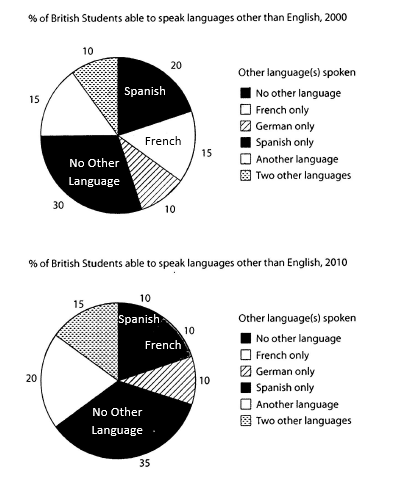
The charts below show the proportions of British students at one university in England who were able to speak other languages in addition to English, in 2000 and 2010
Summarise the information by selecting and reporting the main features, and make comparisons where relevant.
Student answer (Band 5.0)
The pie charts illustrate the percentage of british students who know various language with english at one university in england between 2000 and 2010.
Overall, most of student do not know how to speak in no other langauge during 2000, while spanish was least known language in 2010.
In 2000, about 20% of british students know how to speak spanish. Moreover, french and german was almost similar with the differences of 5%. However, most of students do not know other language it was accounted 30%, they only know english language. 10% students spoke 2 languages and 15% of students in university spoke another languages.
In 2010, french and spanish language was spoke by students had the same percentage. Therefore, 35% of students use only english language. Although, 20% of students spoke with another language and 10% of students spoke one single other language, which help them to communicate with a lot of students.
AI examiner evaluation
| Criterion | Band |
|---|---|
| Task Achievement / Task Response | 5.0 |
| Coherence and Cohesion | 5.5 |
| Lexical Resource | 5.0 |
| Grammatical Range and Accuracy | 5.0 |
| Overall | 5.0 |
Task Achievement / Task Response: Band 5.0
You identify the charts and report several relevant figures, including Spanish at 20% in 2000, no other language at 35% in 2010, and “another language” at 20% in 2010. However, the overview is partly inaccurate: in 2000, the largest group was students speaking no other language (30%), not “most” students, and Spanish was not the least common category in 2010; Spanish and French were tied at 10%, while German was also 10%. Some categories are unclear or misreported: “10% ... spoke one single other language” does not identify which category, and the comparison that French and German differed by 5% in 2000 needs clearer figures. Select the main changes and state them accurately in a concise overview to make the report more complete.
Coherence and Cohesion: Band 5.5
The response has a recognisable structure: an introduction, an overview, and separate paragraphs for 2000 and 2010. This helps the reader follow the year-by-year account. However, progression within the paragraphs is uneven, and some linking words do not show a clear relationship. For example, “Therefore” does not logically connect the equal French and Spanish figures to the 35% who spoke only English, while “Although” introduces no contrasting clause. The overview also repeats information that could be organised more clearly around the main changes between years. Grouping the figures by whether students spoke only English or one or more additional languages, and using links such as “by contrast” or “meanwhile” only where appropriate, would improve the flow and connections.
Lexical Resource: Band 5.0
You use relevant topic vocabulary such as “percentage,” “spoke,” and “another language,” and the reader can generally understand the categories being described. However, the range is limited and several word choices or forms are inaccurate or repetitive, including “know various language with english,” “no other langauge,” and “spoke with another language.” These expressions make some details less precise, especially when describing language ability. Spelling errors such as “british” and “langauge” also reduce accuracy. Use the chart’s category labels consistently and choose natural reporting phrases, for example, “were able to speak,” “accounted for,” and “the proportion of students.” This would make the description clearer and more appropriate to an academic report.
Grammatical Range and Accuracy: Band 5.0
You attempt both simple and more complex sentences, including clauses beginning with “while,” “although,” and “which.” However, errors are frequent and sometimes make relationships between ideas difficult to follow. Examples include “most of student do not know,” “french and german was almost similar,” and “french and spanish language was spoke,” where agreement and verb forms are not controlled. The sentence “Although, 20% of students spoke with another language and 10% ...” is also structurally incomplete because “although” signals a contrast that is not finished. Practise accurate subject–verb agreement, past-tense reporting, articles, and complete clause structures. Shorter, well-controlled sentences would help you communicate the figures reliably while you build more complex forms.
See this exact question answered at other band scores. The same prompt compared across bands.
Browse more IELTS Writing model answers or get your own writing scored by the same AI examiner.