Band 5.5 IELTS Writing Task 1 Model Answer
Overall Band Score: 5.5 · Cambridge IELTS 11 · 2026-11-27
IELTS Writing Task 1 question
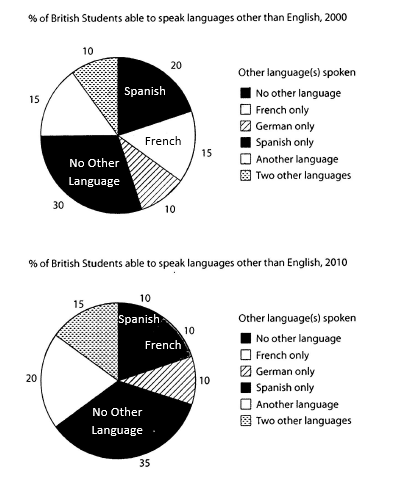
The charts below show the proportions of British students at one university in England who were able to speak other languages in addition to English, in 2000 and 2010
Summarise the information by selecting and reporting the main features, and make comparisons where relevant.
Student answer (Band 5.5)
The pie charts illustrate the percentages of British undergratuates who were capable to speak other languages including English at a specific university, over a 10-year period from 2000 to 2010.
Overall, it is evident that no other language recorded the largest proportion in both years, while two another languages and another language each increased, both Spanish and Frensh decreased, whilst German only remained unchanged.
In 2000, no other language accounted for the highest percentage at 30% of the total students, Spanish ranked second at 20%, followed by both Frensh and Frensh only which took up an identical proportions at 15%, same as German only and two other language each drew an equal figures at 10%.
In 2010, no other language decreased to 32%. however, it remained the highest percentage, Frensh only and two other language each rose with 5% to 20% and 15% respectively, while Spanish and Frensh fell to 10% each, German only language remaind unchanged during the whole period which made up only 10%.
AI examiner evaluation
| Criterion | Band |
|---|---|
| Task Achievement / Task Response | 6.0 |
| Coherence and Cohesion | 6.0 |
| Lexical Resource | 5.5 |
| Grammatical Range and Accuracy | 5.0 |
| Overall | 5.5 |
Task Achievement / Task Response: Band 6.0
You identify the main overall pattern: “No other language” is the largest category in both years, and German remains unchanged. You also report several relevant changes, including the falls in Spanish and French and the rises in “another language” and “two other languages.” However, some figures are inaccurate or confusing: “no other language decreased to 32%” in 2010, whereas the chart shows 35%, and the 2000 description mistakenly refers to “Frensh and Frensh only” rather than French and German. The overview is relevant, but the category comparisons are not consistently precise, and the 2010 figures are not all clearly presented. Check each label against the chart and distinguish the categories carefully to make the summary more complete and reliable.
Coherence and Cohesion: Band 6.0
The response has a clear four-part structure: an introduction, an overview, and separate descriptions of the two years. This gives the reader a generally coherent route through the information, and phrases such as “Overall” and “In 2010” help signal the stages. However, some linking is awkward or mechanical, particularly the long overview sentence joined by “while” and “whilst.” The 2010 paragraph also combines several comparisons in one sentence, making the relationships between categories harder to follow. The transition “however” after a full stop is not capitalised, and the repeated year-by-year listing could be made more cohesive by grouping categories that rose, fell, or stayed stable. Clearer sentence boundaries and more precise referencing would strengthen progression.
Lexical Resource: Band 5.5
You use a reasonable range of task-related vocabulary, including “accounted for,” “ranked second,” “proportion,” and “remained unchanged.” These choices help communicate comparisons, but several word-choice, collocation, and spelling problems reduce precision. “Capable to speak” is not a natural expression here, and “including English” conflicts with the task’s focus on languages in addition to English. “Two another languages” and “Frensh” are also inaccurate forms, while “rose with 5%” is an awkward way to describe a change. Some category labels are repeated without consistent wording. Aim to use the chart’s labels accurately and choose natural comparison phrases; this will make your vocabulary more precise and appropriate for an academic report.
Grammatical Range and Accuracy: Band 5.0
You attempt both simple and more complex sentence forms, including a comparative overview and sentences with clauses linked by “while.” The main meaning is usually recoverable, but some grammatical errors remain and occasionally make the comparisons difficult to interpret. For example, “both Spanish and Frensh decreased” does not fit smoothly with the surrounding clause, and “German only and two other language each drew an equal figures” has problems with agreement and sentence structure. In “Frensh only and two other language each rose with 5%,” the construction is not grammatically controlled. There are also punctuation issues, such as beginning “however” with a lowercase letter after a full stop. Use shorter, well-formed comparison sentences and check agreement, plurals, and punctuation.
See this exact question answered at other band scores. The same prompt compared across bands.
Browse more IELTS Writing model answers or get your own writing scored by the same AI examiner.