Band 5.5 IELTS Writing Task 1 Model Answer
Overall Band Score: 5.5 · Cambridge IELTS 11 · 2026-11-27
IELTS Writing Task 1 question
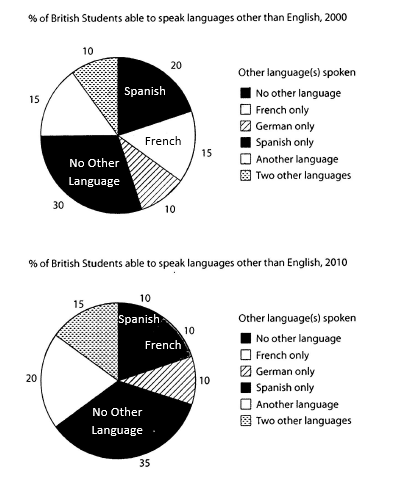
The charts below show the proportions of British students at one university in England who were able to speak other languages in addition to English, in 2000 and 2010
Summarise the information by selecting and reporting the main features, and make comparisons where relevant.
Student answer (Band 5.5)
The pie chart illustrates the proportions of British students at one university in England who were able to speak other languages in addition to English between 2000 and 2010
Nearly half of the students spoke no other language in 2000 and 2010, while Spanish and French decreased slightly in 2010. However, the number of participants who spoke two other languages has risen steadily in recent years
On the one hand, no other language spoken among British students marked the highest propotion in 2000 , while german and two other languages only lie at 10% each. However, French and another language spoken by students were on the same table with 15% each, while Spanish was the second most spoken language among British students other than English in 2000
On the other hand, English increased by 5% during the 10-year gap, while French and Spanish dropped significantly in recent years. The number of British students who could speak German remained the same over the decade. Although the number of individuals who can speak two other languages and various other languages has risen by 5% in 10 years
AI examiner evaluation
| Criterion | Band |
|---|---|
| Task Achievement / Task Response | 5.5 |
| Coherence and Cohesion | 4.5 |
| Lexical Resource | 5.5 |
| Grammatical Range and Accuracy | 5.5 |
| Overall | 5.5 |
Task Achievement / Task Response: Band 5.5
You identify several relevant features, including the largest category in 2000, the unchanged German figure, and the rise in students speaking two other languages. However, the overview is not fully accurate: “Nearly half” spoke no other language, whereas the chart shows 30% in 2000 and 35% in 2010. The claim that Spanish and French “decreased slightly” is also imprecise: Spanish fell from 20% to 10%, while French fell from 15% to 10%. Most importantly, “English increased by 5%” misreads the chart; this should be the no-other-language category. The response reports some figures but leaves the overall comparison underdeveloped and includes this significant misinterpretation. State the main shifts accurately and compare the categories more clearly.
Coherence and Cohesion: Band 4.5
The response has a basic paragraph structure, moving from an overview to separate comments on 2000 and 2010, and phrases such as “On the other hand” signal a change in focus. However, progression is not consistently clear: “On the one hand” and “On the other hand” suggest a contrast that the paragraphs do not establish, and “in recent years” is repeated despite the charts comparing two specific years. The final sentence beginning “Although” is incomplete, leaving the relationship between the increases unclear. Some information is also repeated rather than grouped into a direct comparison. Organise the body around categories that rose, fell, or stayed unchanged, and use linking phrases only when their logical relationship is clear.
Lexical Resource: Band 5.5
You use some task-relevant vocabulary, including “proportions,” “remained the same,” and “dropped,” which helps communicate comparisons. There is also an attempt to vary expressions, such as “participants” and “individuals.” However, several choices are inaccurate or unnatural: “English increased by 5%” names the wrong category, “on the same table” is not an appropriate way to say that two figures were equal, and “propotion” is misspelled. “Risen steadily in recent years” is also too broad for a comparison of only two years. Use precise chart language such as “the proportion speaking no other language,” “stood at the same level,” and “increased by five percentage points.” This would make the vocabulary more accurate and suitable for data reporting.
Grammatical Range and Accuracy: Band 5.5
You attempt a mixture of simple and complex sentences, including clauses introduced by “while” and “although,” and the main comparisons are generally understandable. However, some sentence structures are incomplete or awkward. The final sentence starts with “Although” but has no main clause, so it does not form a complete sentence. In “German and two other languages only lie at 10% each,” the present-tense verb does not fit the past-year description, and the sentence needs clearer grammatical framing. Punctuation is also inconsistent, with spaces before commas and missing full stops. Use complete sentences, maintain past tense when describing the 2000 and 2010 data, and check clause boundaries and punctuation. These corrections would improve control while retaining your attempts at complex forms.
See this exact question answered at other band scores. The same prompt compared across bands.
Browse more IELTS Writing model answers or get your own writing scored by the same AI examiner.