Band 5.0 IELTS Writing Task 1 Model Answer
Overall Band Score: 5.0 · Cambridge IELTS 11 · 2026-11-28
IELTS Writing Task 1 question
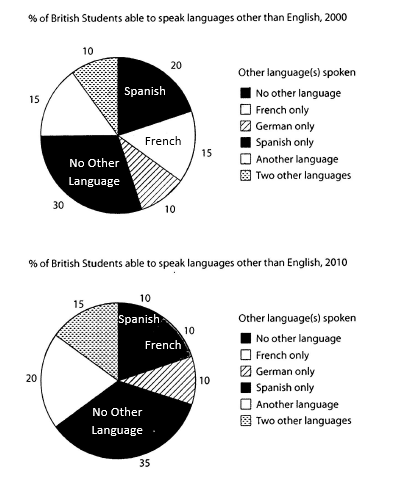
The charts below show the proportions of British students at one university in England who were able to speak other languages in addition to English, in 2000 and 2010
Summarise the information by selecting and reporting the main features, and make comparisons where relevant.
Student answer (Band 5.0)
The charts illustrates different type of languages british students at one university in united kingdom but some are speaks other languages to English between 2000 to 2010
overall British students were able to speaks others language's in 2000 first are no other languages speaks then french only and German only and Spanish only and another language only and two other languages . In 2010 they talk about same languages
First of all i am going to discuss no other languages in 2000 was 30 percentage then Spanish was 20% then French was 15 % another language was also same in 2000 that were 15% and last two other languages and German only were same in 2000 that both was 10%
Now i am going to illistrates 2010 chart no other languages was 35% that's are to much heigh rather than others then another language was 20% then two other languages was 15% then spanish franch and German only three was same in 2020 that was 10%
AI examiner evaluation
| Criterion | Band |
|---|---|
| Task Achievement / Task Response | 4.5 |
| Coherence and Cohesion | 5.5 |
| Lexical Resource | 4.5 |
| Grammatical Range and Accuracy | 4.5 |
| Overall | 5.0 |
Task Achievement / Task Response: Band 4.5
You report several figures accurately, including 30% for students speaking no other language in 2000, 35% in 2010, and the 2010 figures for other languages. However, the response gives little clear overview of the main changes: it does not highlight that Spanish fell from 20% to 10%, while “another language” and “two other languages” increased. The opening overview mostly lists categories rather than summarising the key pattern, and the final reference to “2020” misidentifies the chart year. Some comparisons are present, but the task is addressed only partially because the most significant changes between the two charts are not clearly selected and reported.
Coherence and Cohesion: Band 5.5
The response has a basic three-part structure: an introduction, a paragraph about 2000, and one about 2010. Phrases such as “First of all” and “Now I am going to” signal the order of discussion, so the reader can generally follow the chart-by-chart approach. However, progression is limited because the two years are described separately rather than connected through direct comparisons. The overview repeats category names without establishing a clear main message, and several long, loosely joined sentences make relationships between figures harder to follow. Use a concise overview followed by grouped comparisons, with linking phrases such as “by contrast” and “while” used to show changes clearly.
Lexical Resource: Band 4.5
You use some relevant chart vocabulary, including “percentage,” “same,” and “rather than,” and the language is generally recognisable as an attempt to describe proportions. However, the range is basic and repetitive, with frequent awkward or inaccurate choices such as “different type of languages,” “they talk about same languages,” and “to much heigh.” These expressions sometimes strain the reader and do not convey the data precisely. Spelling errors such as “illistrates” and “franch” also reduce clarity. Build a more accurate set of Task 1 terms for describing shares and change, and check spelling and collocations before finishing.
Grammatical Range and Accuracy: Band 4.5
The response attempts mostly simple statements and uses a few longer sentences, but grammatical control is weak and errors occur throughout. For example, “The charts illustrates” has a subject–verb agreement error, while “students … who … speaks” uses an incorrect verb form. Articles, plurals, and sentence boundaries are also unreliable, as in “then French only and German only and Spanish only,” which is not formed as a complete, clearly punctuated sentence. The final sentence shifts to “2020” despite discussing the 2010 chart. These problems sometimes make the intended relationships difficult to understand. Practise accurate simple sentences first, then combine comparisons using controlled clauses such as “while” and “whereas.”
See this exact question answered at other band scores. The same prompt compared across bands.
Browse more IELTS Writing model answers or get your own writing scored by the same AI examiner.