Band 5.5 IELTS Writing Task 1 Model Answer
Overall Band Score: 5.5 · Cambridge IELTS 11 · 2026-11-28
IELTS Writing Task 1 question
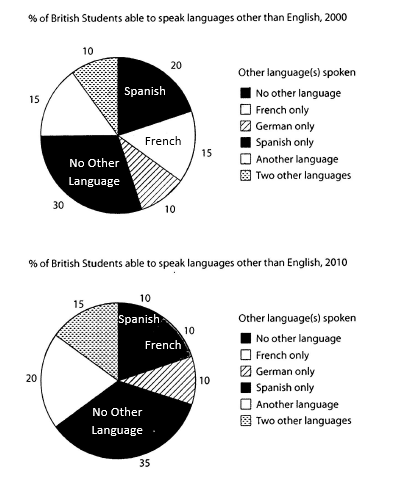
The charts below show the proportions of British students at one university in England who were able to speak other languages in addition to English, in 2000 and 2010
Summarise the information by selecting and reporting the main features, and make comparisons where relevant.
Student answer (Band 5.5)
The presented chart illustrates the proportions of British students at one university in England who were able to speak other languages in addition to english, in 2000 and 2010.
Overall, those who were not able to speak another language accounted the largest proportion in both years. However, the percentage of german speakers remained static, while the percentage of students who were able to speak spanish and french decreased over the period.
It can be seen that, in 2000 30% students cannot speak another language, while it increased to 35% in 2010. However, 20% students was able to speak spanish and 15% french. The percentage decreased in 2010 only 10% could speak frech and spanish. Meanwhile, those who were able to speak two other languages increased from 10% to 15%. Whereas those who speaks only french were 15% in 2000 and it increased to 20% in 2010, while the proportion of only german speakers remained same in both years 10%.
AI examiner evaluation
| Criterion | Band |
|---|---|
| Task Achievement / Task Response | 5.5 |
| Coherence and Cohesion | 5.0 |
| Lexical Resource | 5.5 |
| Grammatical Range and Accuracy | 5.5 |
| Overall | 5.5 |
Task Achievement / Task Response: Band 5.5
You identify the main overall pattern: students speaking no other language formed the largest group in both years, and the shares for Spanish and French fell. Several figures are also reported accurately, including no other language (30% to 35%), Spanish (20% to 10%), and two other languages (10% to 15%). However, the account misreports the “another language” category: it rose from 15% to 20%, but you describe those figures as French-only speakers. This leaves an important category unclear and makes the comparison inaccurate. The response also contains only 134 words, below the required 150, so the summary is underdeveloped; add a clear comparison of the remaining categories and ensure the report meets the minimum length.
Coherence and Cohesion: Band 5.0
The response has a recognisable structure, with an introduction, an overview, and a paragraph of figures. This helps the reader follow the broad comparison between 2000 and 2010. However, progression within the final paragraph is uneven: the discussion moves from no other language to Spanish and French, then to two languages, and finally returns to French-only and German, without grouping related categories consistently. Connectors such as “However,” “Meanwhile,” and “Whereas” are used, but some do not clearly express the relationship between the information, and “Whereas” begins a fragment-like construction. Organise the details into clearer comparisons—for example, declining categories together and increasing or unchanged categories together—and use linking words only where their relationship is precise.
Lexical Resource: Band 5.5
You use relevant task vocabulary such as “proportions,” “accounted,” “percentage,” and “remained static,” and the meaning is generally understandable. However, the range is somewhat repetitive, with frequent reliance on “percentage,” “speak,” and “able to speak.” Some wording is imprecise or awkward: “accounted the largest proportion” needs a more natural construction, and “those who speaks only french” contains an unsuitable word form and spelling/capitalisation problems. The phrase “the percentage decreased in 2010 only 10%” also does not clearly express the change. Use more precise reporting language, such as “the share fell to 10%,” and distinguish carefully between “another language” and “two other languages” so category labels remain clear.
Grammatical Range and Accuracy: Band 5.5
You attempt both simple and more complex sentence forms, including a contrast with “while” and a clause beginning “those who were able to speak two other languages.” The main comparisons can usually be understood, but errors in agreement, articles, and sentence construction recur. For example, “20% students was able” should be “20% of students were able,” while “those who speaks” should be “those who spoke.” The sentence “The percentage decreased in 2010 only 10% could speak…” joins ideas without a clear grammatical link; use a full clause such as “By 2010, the figure had fallen to 10%.” Check punctuation after introductory time phrases and make sure each contrast clause forms a complete sentence.
See this exact question answered at other band scores. The same prompt compared across bands.
Browse more IELTS Writing model answers or get your own writing scored by the same AI examiner.