Band 5.5 IELTS Writing Task 1 Model Answer
Overall Band Score: 5.5 · Cambridge IELTS 15 · 2026-11-07
IELTS Writing Task 1 question
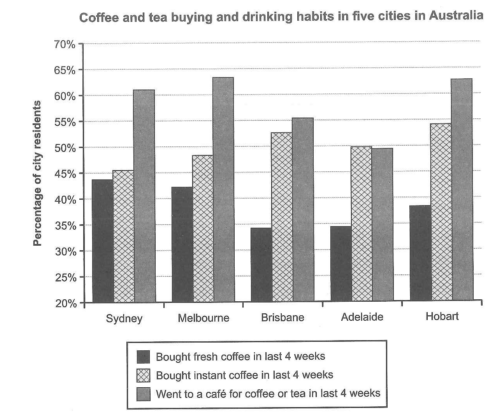
The chart below shows the results of a survey about people’s coffee and tea buying and drinking habits in five Australian cities.
Summarize the information by selecting and reporting the main features, and make comparisons where relevant.
Student answer (Band 5.5)
The chart illustrates the habits of drinking and purchasing coffee and tea between individuals from five Australian cities through survey results.
Overall, visiting a cafe for coffee or tea appeared more in trend than purchasing it fresh. People of Adelaida showed more interest in instant coffee than buying it fresh. There is similar habits of purchasing fresh coffee in Brisbane and Adelaide. Although individuals from Brisbane and Hobart showed the higher trend in purchasing instant coffee.
Between 61% and 64% of residents of four cities (Sydney, Melbourne, Brisbanae and Hobart) loved to visit cafe for coffee and tea while only 49% individuals from Adelaide showed the interest. Around 46% of people from Sydney have habits of purchasing fresh coffee and only 43% individuals showed interest in instant coffee.
Brisbane residents have more trend of visiting cafe or purchasing instant coffee than getting it fresh
AI examiner evaluation
| Criterion | Band |
|---|---|
| Task Achievement / Task Response | 5.0 |
| Coherence and Cohesion | 5.0 |
| Lexical Resource | 5.5 |
| Grammatical Range and Accuracy | 5.5 |
| Overall | 5.5 |
Task Achievement / Task Response: Band 5.0
You identify the chart’s broad pattern that café visits were generally more common than buying fresh coffee, and you note Adelaide’s lower café figure and the similar fresh-coffee results in Brisbane and Adelaide. However, the report covers the data only partially and includes a significant misreading: Sydney’s fresh-coffee figure is about 44%, while its instant-coffee figure is about 45.5%, not the reverse stated in your paragraph. The claim that Brisbane and Hobart had the highest instant-coffee trend is also inaccurate; Hobart was highest, followed by Brisbane, but Adelaide was higher than Brisbane. The final sentence is incomplete as a comparison and the response is six words below the required minimum. Include a fuller, accurate overview and compare all three categories across the cities.
Coherence and Cohesion: Band 5.0
The response has a recognisable structure, with an introduction, an overview and paragraphs containing details, so the reader can identify the intended topic. However, progression is limited: the overview lists several separate observations without organising them into the chart’s main comparisons, and the final paragraph is only one sentence and does not develop the point. Connections between ideas are sometimes unclear, as in “Although individuals from Brisbane and Hobart showed the higher trend,” where the contrast introduced by “Although” is not completed. Some linking and reference are also awkward, including “There is similar habits.” Group the information by category or by notable city comparisons, and use complete, clearly connected sentences to guide the reader through the data.
Lexical Resource: Band 5.5
You use relevant chart vocabulary such as “survey results,” “residents,” “purchasing,” and “trend,” and the meaning is generally recoverable. However, several choices are imprecise or unnatural for describing statistical data: people do not usually “love to visit” a café in a neutral report, and “showed more interest” suggests motivation rather than a measured percentage. There are also spelling errors in city names, including “Adelaida” and “Brisbanae,” which reduce accuracy. Repeated use of “trend” and “interest” limits precision. Prefer neutral reporting language such as “the proportion who visited” or “the figure for instant coffee,” and check the spelling of all place names.
Grammatical Range and Accuracy: Band 5.5
You attempt some complex sentence forms, including the sentence beginning “Although,” and use past-tense reporting in places. However, grammatical control is uneven, and several errors make the relationships between ideas less clear. For example, “There is similar habits” has a subject–verb agreement error, while “Between 61% and 64% of residents of four cities … loved to visit” has an awkwardly constructed subject and verb pattern. The “Although” clause is left without a complete contrasting main clause, and “only 49% individuals” is missing an article. The final sentence also lacks a full comparison structure. Practise accurate agreement, articles and complete complex sentences, while varying sentence patterns without leaving clauses unfinished.
See this exact question answered at other band scores. The same prompt compared across bands.
Browse more IELTS Writing model answers or get your own writing scored by the same AI examiner.