Band 5.5 IELTS Writing Task 1 Model Answer
Overall Band Score: 5.5 · Cambridge IELTS 15 · 2026-11-08
IELTS Writing Task 1 question
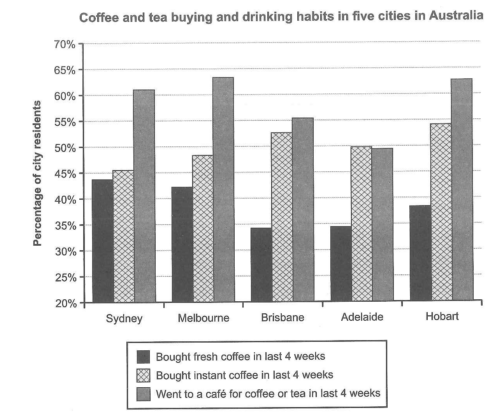
The chart below shows the results of a survey about people’s coffee and tea buying and drinking habits in five Australian cities.
Summarize the information by selecting and reporting the main features, and make comparisons where relevant.
Student answer (Band 5.5)
this bar chart illustrates a survey results of percentage of people buying and drinking coffee in 5 different cities of australia .
overall percentage of individuals went to cafe to buy coffee is high in all cities with the exception of adelaide where people likes to buy instant cioffee more.in contrast less people like to buy fresh coffee in all cities with some fluctuation.
to begin with highest percentage tof people like to go to cafe and buy coffee in last 4weeks is highest in melborne with around 64%.hobart closely catching up with the melborne with about 63%of people like to to cafe and buy coffee.adelaide experience a tottal contrast with more people, about 49% wants to buy instant coffee as compare to 48 %of people who wants to go to cafe to buy their coffee.rest of the cituies hold a position of arount 61 for sydney and 55% for brisbane.
percentage of the people wants to buy freash is the lowest in all cities with the least number of people in brisbane,around 34%,who wants to buy fresh coffee.moreover in Sydney people likes to buy fresh coffee more with the percantage of about 43%which is highest among all.
AI examiner evaluation
| Criterion | Band |
|---|---|
| Task Achievement / Task Response | 5.5 |
| Coherence and Cohesion | 6.5 |
| Lexical Resource | 5.5 |
| Grammatical Range and Accuracy | 5.0 |
| Overall | 5.5 |
Task Achievement / Task Response: Band 5.5
You identify the main pattern that café visits were generally popular and fresh coffee purchases were comparatively low, and you include several relevant city figures. However, some key comparisons are inaccurate or unclear: Melbourne, not Hobart, had the highest café figure (about 63.5%, versus Hobart’s 63%), and Adelaide’s café figure was about 49.5%, while instant coffee was 50%, not 49% versus 48%. The overview also overgeneralises that café visits were highest in every city; in Adelaide, instant coffee purchases were slightly higher. Fresh coffee was lowest in Brisbane and Adelaide jointly, rather than Brisbane alone. More precise reporting of all three categories and a clearer overview would make the response more complete and better supported.
Coherence and Cohesion: Band 6.5
The response has a recognisable overall structure: an introduction and overview are followed by paragraphs describing café visits and fresh coffee. This gives the reader a basic route through the information, and phrases such as “in contrast” and “moreover” show an attempt to connect ideas. The progression is not fully controlled, however. The first detail paragraph moves from Melbourne and Hobart to Adelaide, then groups Sydney and Brisbane without explaining the comparison, while the final paragraph covers only fresh coffee and leaves instant coffee largely unreported. Some links are also awkward or unclear, such as “rest of the cituies hold a position.” Grouping cities by the highest and lowest results for each category would create a more logical, balanced progression.
Lexical Resource: Band 5.5
You use some relevant vocabulary for describing a chart, including “percentage,” “fluctuation,” “contrast,” and “highest,” and the reader can generally understand the intended comparisons. However, the range is limited and several word choices or collocations are inaccurate, such as “people likes to buy,” “go to cafe and buy coffee,” and “a total contrast.” Spelling errors—including “cioffee,” “melborne,” “tottal,” and “freash”—are noticeable and sometimes make the text harder to read. Also, the chart distinguishes buying fresh or instant coffee from going to a café for coffee or tea, so repeatedly describing café visits as buying coffee is imprecise. Use accurate category labels and practise spelling key terms before writing.
Grammatical Range and Accuracy: Band 5.0
You attempt both simple statements and longer comparisons, for example, “Adelaide experience a total contrast with more people…” This shows some effort to vary sentence structure, but control is inconsistent, and errors occur frequently enough to affect clarity. Subject–verb agreement is a recurring problem: “people likes” and “Adelaide experience” should use plural and singular forms respectively. There are also problems with articles, infinitives, and sentence boundaries, as in “go to cafe,” “like to to cafe,” and the run-on transition between the opening overview and the next sentence. Capitalisation and punctuation are also unreliable. Build accuracy with shorter, complete sentences first, then add controlled comparisons using correct agreement and punctuation.
See this exact question answered at other band scores. The same prompt compared across bands.
Browse more IELTS Writing model answers or get your own writing scored by the same AI examiner.