Band 4.5 IELTS Writing Task 1 Model Answer
Overall Band Score: 4.5 · Cambridge IELTS 15 · 2026-11-10
IELTS Writing Task 1 question
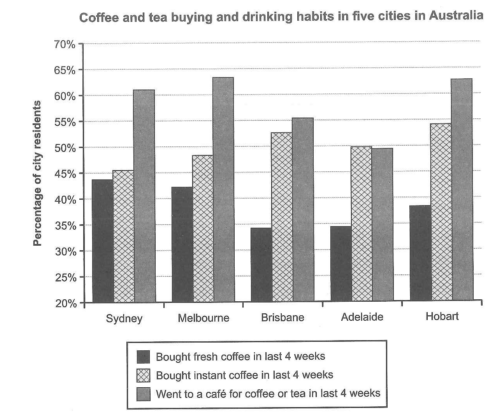
The chart below shows the results of a survey about people’s coffee and tea buying and drinking habits in five Australian cities.
Summarize the information by selecting and reporting the main features, and make comparisons where relevant.
Student answer (Band 4.5)
In this report we elobrate the drinking habits of people in five australian cities in last four weeks. which are sydney, melbourne, brisbane, adelaide and hobart.
Mostly people went to cafe for drinking tea and coffee in all cities molbourne had most number of people and in adelaid had the least number of peoples .
secondly , instant coffee bought by most of the people and least number of people bought fresh coffees in recent four weeks .
AI examiner evaluation
| Criterion | Band |
|---|---|
| Task Achievement / Task Response | 4.0 |
| Coherence and Cohesion | 5.0 |
| Lexical Resource | 5.0 |
| Grammatical Range and Accuracy | 4.5 |
| Overall | 4.5 |
Task Achievement / Task Response: Band 4.0
You identify the topic and name all five cities, and you report two relevant broad patterns: café visits are generally popular, while instant coffee purchases exceed fresh coffee purchases in most cities. However, the response gives no figures or city-by-city comparisons, and the claim that Melbourne had the most café visits is inaccurate: Sydney is slightly lower, while Melbourne and Hobart are close, with Melbourne marginally higher in the transcribed data. The statement that Adelaide had the fewest café visits is accurate. The overview is too brief to summarise the main features fully, and the response does not meet the 150-word minimum, so the task is addressed only minimally. Add key percentages and compare the highest and lowest results across all three categories.
Coherence and Cohesion: Band 5.0
The response has a basic sequence: it introduces the chart, then gives a general observation about café visits, followed by a point about coffee purchases. This gives the reader some organisation, and words such as “secondly” signal a move to another feature. However, the ideas are compressed into one paragraph, and there is little progression from an overview to supporting details. The transition “secondly” does not clearly connect the purchase comparison to the café figures, while the opening fragment beginning “which are” interrupts the flow. Use separate paragraphs for the introduction, overview and comparisons, and link each comparison explicitly to the relevant cities and data.
Lexical Resource: Band 5.0
You use some relevant task vocabulary, including “drinking habits,” “cafe,” “instant coffee” and “fresh coffees,” so the subject is generally understandable. However, the range is limited and several choices are imprecise or repetitive: “most number of people” and “least number of peoples” are awkward ways to describe proportions, and “fresh coffees” is less suitable than the chart’s category “fresh coffee.” There are also noticeable spelling errors in “elobrate,” “australian,” “molbourne” and “adelaid,” which reduce accuracy. Use concise chart language such as “the highest proportion,” “the lowest figure” and “residents who bought fresh coffee,” and check spelling and capitalisation of city names.
Grammatical Range and Accuracy: Band 4.5
The response attempts a few sentence patterns, including a relative clause in “cities … which are Sydney, Melbourne, Brisbane, Adelaide and Hobart,” but the clause is incomplete and should be joined to the preceding sentence. The opening “In this report we elobrate…” is followed by a fragment beginning “which are,” and the second sentence also lacks a clear grammatical structure around “in adelaid had the least number.” Capitalisation and punctuation are inconsistent, including the lower-case city names and the full stop before “which.” Most of the writing relies on simple constructions, with little accurate variety. Practise complete sentences with clear subjects and verbs, for example, “The chart compares…” and “Café visits were highest in…”
See this exact question answered at other band scores. The same prompt compared across bands.
Browse more IELTS Writing model answers or get your own writing scored by the same AI examiner.