Band 5.0 IELTS Writing Task 1 Model Answer
Overall Band Score: 5.0 · Cambridge IELTS 15 · 2026-11-10
IELTS Writing Task 1 question
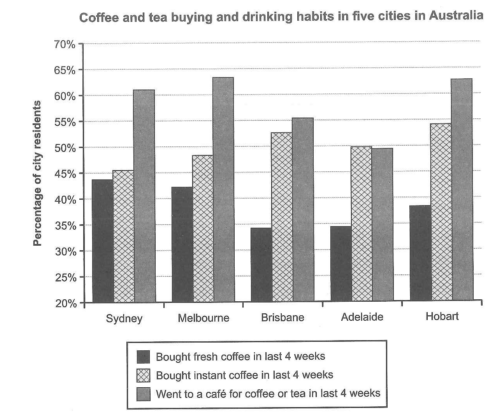
The chart below shows the results of a survey about people’s coffee and tea buying and drinking habits in five Australian cities.
Summarize the information by selecting and reporting the main features, and make comparisons where relevant.
Student answer (Band 5.0)
The bar graph here depicts the drinking and buying habits of tea and coffee of the residents of five different cities of Australia in last 4 weeks. Most of the people went to cafe for coffee or tea in last 4 weeks. Many people didn;t like to buy fresh coffee and make it at home. In Adelaide, about 50% of population is fond of coffee and bought fresh and instant coffee both in last month. The percentage of people in Melbourne who went to cafe is 63% whereas 55% of Brisbane citizens went to cafe. Hobart people bought most instant coffee among the five cities of Australia. The data of Sydney reported that 44% of population bought fresh coffee in last 4 weeks. The data is almost same for the population who like to drink instant coffee. Hobart and Melbourne has the same percentage of people who like to go to cafe for tea and coffee.
AI examiner evaluation
| Criterion | Band |
|---|---|
| Task Achievement / Task Response | 5.5 |
| Coherence and Cohesion | 4.0 |
| Lexical Resource | 5.5 |
| Grammatical Range and Accuracy | 5.5 |
| Overall | 5.0 |
Task Achievement / Task Response: Band 5.5
You identify relevant features, including café visits as a prominent activity and Hobart as having the highest instant-coffee figure. You also give several city comparisons, such as Melbourne at about 63% and Brisbane at about 55% for café visits. However, the overview is broad and not fully accurate: café attendance is not highest in every city, and Hobart and Melbourne are close but not exactly the same. The statement that Adelaide’s population is “fond of coffee” and bought both types at about 50% is unclear and conflates separate categories; fresh-coffee purchases there were notably lower. To strengthen the response, summarise the main contrasts across all three activities and report the figures precisely, rather than making unsupported claims about preferences.
Coherence and Cohesion: Band 4.0
The response contains relevant information and moves from a general opening to examples from individual cities, so the reader can follow its broad subject. However, it is presented as one continuous paragraph, with no clear separation between an overview and supporting details. The sequence also feels like a list of observations: Adelaide, Melbourne and Brisbane are followed by Hobart and then Sydney, without a consistent comparison pattern. Some links between ideas are unclear, particularly the sentence about Adelaide, which combines population preference with two purchase categories. Organise the response into an introduction, a concise overview and grouped comparisons, for example discussing café visits first and coffee purchases second.
Lexical Resource: Band 5.5
You use enough topic vocabulary to communicate the general subject, including “bar graph,” “percentage,” “population” and “instant coffee.” There are also attempts to vary phrasing, such as “went to cafe” and “bought fresh coffee.” However, several expressions are imprecise or unnatural for describing survey data: “fond of coffee” suggests personal preference rather than a reported action, and “the data ... reported” is an awkward collocation. “Many people didn’t like to buy fresh coffee” also makes an unsupported claim about dislike. Choose neutral, accurate terms such as “residents,” “the proportion who purchased,” and “visited a café.” Check spelling and apostrophes, including “didn’t,” to make the writing more polished.
Grammatical Range and Accuracy: Band 5.5
You produce several understandable simple sentences and attempt longer structures, including the comparison beginning “The percentage of people in Melbourne ... whereas ...”. Meaning is generally recoverable, but errors in agreement, articles and sentence construction remain noticeable. For example, “Hobart and Melbourne has” should use a plural verb, while “went to cafe” needs an article. The opening phrase “in last 4 weeks” also lacks the required article, and “The data of Sydney reported” has an awkward grammatical construction. Some sentences join several ideas without clear grammatical relationships, especially the Adelaide sentence. Practise accurate comparison patterns and check subject–verb agreement, articles and sentence boundaries.
See this exact question answered at other band scores. The same prompt compared across bands.
Browse more IELTS Writing model answers or get your own writing scored by the same AI examiner.