Band 6.5 IELTS Writing Task 1 Model Answer
Overall Band Score: 6.5 · Cambridge IELTS 15 · 2026-11-11
IELTS Writing Task 1 question
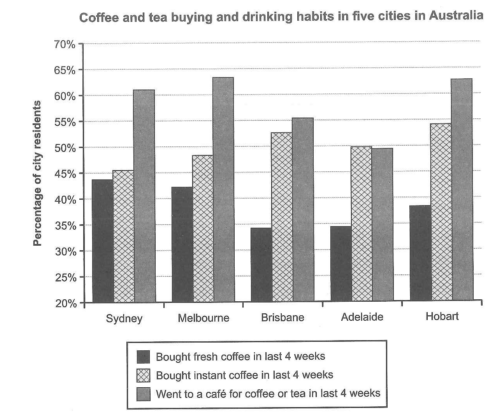
The chart below shows the results of a survey about people’s coffee and tea buying and drinking habits in five Australian cities.
Summarize the information by selecting and reporting the main features, and make comparisons where relevant.
Student answer (Band 6.5)
The bar charts compare thye results of a survey on coffee and tea buying and drinking habits among people living in five autralian cities.
Overall, visiting cafe's was the most popular acitivity in most cities, except Adelaide. It is also clear that instant coffee was more popular than fresh coffee in all cities.
Looking at cafe visits, Melbourne and Hobert recorded the highest figure at around 65%.More than half of the residents in Sidney and Brisbane also visited a cafe in the previous month. However, Adelaide had the lowest percentage , at just under 50%. Intersingly, the figures for cafe visitors and instant coffee buyers in Adelaide was almost similar.
Regarding coffee purchases, instant coffee was more popular than fresh coffee in every city. The percentage of people buying fresh coffee ws under 45% in all locations. Adelaide and Brisbane had the lowest figures, at less than 35% . In contrast, Sydney showed the smallest difference between fresh and instant coffee purchases.
AI examiner evaluation
| Criterion | Band |
|---|---|
| Task Achievement / Task Response | 6.5 |
| Coherence and Cohesion | 7.0 |
| Lexical Resource | 6.0 |
| Grammatical Range and Accuracy | 6.0 |
| Overall | 6.5 |
Task Achievement / Task Response: Band 6.5
The response identifies the main patterns accurately: café visits lead in most cities, Adelaide is the exception, and instant coffee purchases exceed fresh coffee purchases everywhere. It also selects useful comparisons, including the high café figures in Melbourne and Hobart and the low fresh-coffee figures in Brisbane and Adelaide. These points support a clear overview and show some effective selection of key features. However, a few details are imprecise: Melbourne and Hobart are described as both reaching “around 65%,” although Hobart is about 63% and Melbourne about 63.5%; Sydney’s café figure is also above 60%, rather than merely “more than half.” The final comparison about Sydney having the smallest purchase gap is relevant, but could be supported with figures. More precise reporting and fuller development of selected comparisons would strengthen the response further.
Coherence and Cohesion: Band 7.0
The organisation is clear and easy to follow. A brief introduction is followed by an overview, then separate paragraphs on café visits and coffee purchases, giving the reader a logical route through the data. Linking phrases such as “Overall,” “Looking at,” “However,” and “Regarding” help signal shifts between points, and the contrast between café visits and instant-coffee purchases in Adelaide is placed appropriately. To make the progression more polished, connect comparisons more explicitly within each paragraph—for example, contrast the leading café figures with Adelaide’s lower result in one sentence. Some transitions are formulaic, but they do not disrupt understanding. The paragraphing and sequencing are effective; more varied, precise links between related figures would add flexibility.
Lexical Resource: Band 6.0
The response uses an adequate range of task-relevant vocabulary, including “recorded the highest figure,” “percentage,” “lowest figures,” and “difference,” and the meaning is generally clear. It also attempts less common wording such as “Intersingly,” though this is misspelled and the intended word is “Interestingly.” Several spelling errors—“thye,” “autralian,” “Hobert,” “Sidney,” and “ws”—reduce accuracy, while “cafe's” uses an incorrect apostrophe for a plural. Some phrasing is imprecise or repetitive, particularly repeated references to “popular” and “figures.” Use standard chart language consistently, such as “proportion of residents” or “accounted for,” and check spelling and collocations carefully. This would make the vocabulary more precise without requiring unnecessarily complex words.
Grammatical Range and Accuracy: Band 6.0
There is a mix of simple and more complex sentence forms, and most sentences communicate the intended comparisons clearly. The overview uses a contrast clause effectively in “except Adelaide,” while “In contrast” introduces a useful comparison in the final paragraph. Some grammatical errors remain. In “the figures for cafe visitors and instant coffee buyers in Adelaide was almost similar,” the plural subject requires “were,” and “almost similar” is not a well-formed construction; use “were almost the same.” The opening sentence also needs the correct article and possessive structure: “the results of a survey on … habits.” Punctuation spacing is inconsistent, as in “65%.More,” and there is an unnecessary space before the comma after “percentage.” More careful agreement, sentence editing, and punctuation checks would improve accuracy.
See this exact question answered at other band scores. The same prompt compared across bands.
Browse more IELTS Writing model answers or get your own writing scored by the same AI examiner.