Band 5.5 IELTS Writing Task 1 Model Answer
Overall Band Score: 5.5 · Cambridge IELTS 15 · 2026-11-12
IELTS Writing Task 1 question
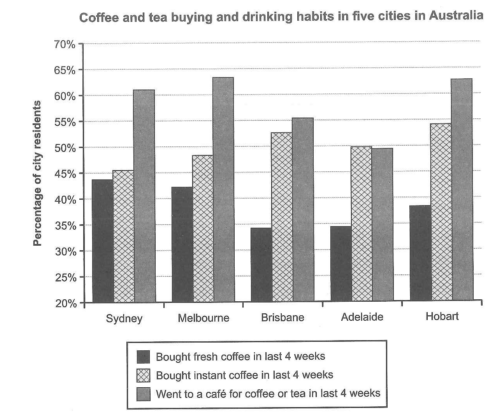
The chart below shows the results of a survey about people’s coffee and tea buying and drinking habits in five Australian cities.
Summarize the information by selecting and reporting the main features, and make comparisons where relevant.
Student answer (Band 5.5)
The chart below shows the results of a survey about people's coffee and tea buying and drinking habits in five Australian cities.
Overall, people in all five cities mostly prefer to go to a cafe to drink coffee. Except from these many people bought instant coffee. The people who bought fresh coffee were the least in each city.
To begin with, in Sydney, Melbourne, Brisbane and, Hobart around 60% to 65% went to cafe to drink coffee. Around 49% of people in Adelaide liked to drink coffee at a cafe. Additionally, people who bought instant coffee in Hobart were 54% and 53% in Brisbane. Around 50% of the people in Adelaide purchased instant coffee. The percentage was less then 58% for Melbourne and 45% for Sydney.
Further analyzing the graph, few people bought fresh coffee. People whop bought fresh coffee in Sydney and Melbourne were around 40% to 45%. Less then 40% people purchased fresh coffee in Hobart. The percentage was less then 35% for Brisbane and Adelaide.
AI examiner evaluation
| Criterion | Band |
|---|---|
| Task Achievement / Task Response | 5.5 |
| Coherence and Cohesion | 6.0 |
| Lexical Resource | 5.5 |
| Grammatical Range and Accuracy | 5.5 |
| Overall | 5.5 |
Task Achievement / Task Response: Band 5.5
You identify the main pattern: café visits are highest in most cities, while fresh-coffee purchases are generally lowest, and you cover all three categories across the five locations. Several figures are broadly accurate, including Adelaide’s café figure and the high instant-coffee proportions in Hobart and Brisbane. However, some comparisons are imprecise: Melbourne’s instant-coffee figure is about 49%, not simply “less than 58%,” and Sydney’s is about 46%, rather than 45%. The overview also says residents “mostly prefer” cafés, which overstates what a survey of recent behaviour establishes. The response is 147 words, three short of the 150-word minimum; the 21 words copied from the prompt are not counted. Add a little more precise comparison and detail.
Coherence and Cohesion: Band 6.0
The response has a clear overall arrangement: an introduction, an overview, and two body paragraphs that group café visits and instant coffee before discussing fresh coffee. This makes the information easy to follow, and phrases such as “To begin with” and “Further analyzing the graph” signal progression. However, the linking is somewhat mechanical, and the overview’s “Except from these” does not clearly explain the relationship between café visits and instant-coffee purchases. The body paragraphs would be more cohesive if comparisons were made directly across cities—for example, contrasting Hobart’s high café and instant-coffee figures with Adelaide’s lower café figure—rather than listing figures in sequence. Use clearer transitions and references to connect these comparisons.
Lexical Resource: Band 5.5
You use relevant vocabulary for describing the chart, including “percentage,” “purchased,” “bought fresh coffee,” and “went to a cafe,” so the meaning is generally clear. There is some repetition of “people,” “percentage,” and “bought,” and several expressions are imprecise or awkward for reporting survey data. For example, “people … mostly prefer” suggests a preference rather than a reported action, while “few people bought fresh coffee” is misleading when the figures are around one-third to two-fifths. “Except from these” is also an inaccurate phrase. Aim for more precise reporting language such as “the proportion who visited a café” and “fresh coffee purchases were lower than instant coffee purchases.” Check spelling and word forms, including “who” in “people whop.”
Grammatical Range and Accuracy: Band 5.5
You use a mix of simple statements and longer structures, and most of the information remains understandable. However, some grammatical errors and awkward constructions recur. In the overview, “Except from these many people bought instant coffee” lacks clear sentence structure and punctuation; “Except for this, many people bought instant coffee” would be clearer. The phrase “in Sydney, Melbourne, Brisbane and, Hobart” has incorrect comma placement, and “Less then 40% people” needs both the correct form “than” and a grammatical construction such as “Fewer than 40% of people.” There are also article and preposition issues in “went to cafe” and “at a cafe.” Practise accurate percentage constructions and articles while retaining the range of sentence forms you attempt.
See this exact question answered at other band scores. The same prompt compared across bands.
Browse more IELTS Writing model answers or get your own writing scored by the same AI examiner.