Band 5.0 IELTS Writing Task 1 Model Answer
Overall Band Score: 5.0 · Cambridge IELTS 15 · 2026-11-16
IELTS Writing Task 1 question
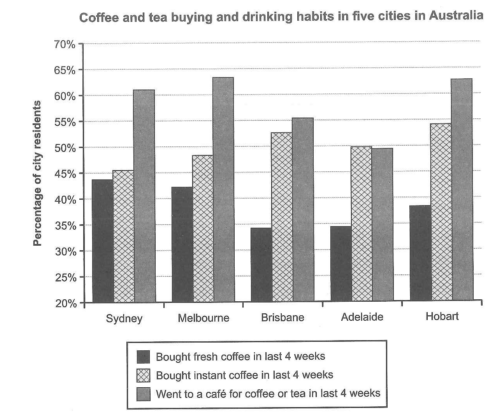
The chart below shows the results of a survey about people’s coffee and tea buying and drinking habits in five Australian cities.
Summarize the information by selecting and reporting the main features, and make comparisons where relevant.
Student answer (Band 5.0)
The charts illustrates the information about a people's who drink coffee and tea in five cities in australia.Also, it mantion the data of people who buy coffee and tea.
firstly, in sydney there was near by 45% people who bought fresh coffee in last 4 week. additionely sydney peoples bought instant coffee near by 45%. the hieghst people around 60% in sydeny who went to a cage for coffee or tea in last 4 weeks. let's move to melbourne there was near by 40% people who bought fresh coffee, near by 50% who bought instant coffee, near by 65% who went to a cafe in last 4 weeks.
on the other hand , in Brisbane there was lowest racio around 30% people who bought fresh coffee, 50% bought instant coffee, 55% went a cafe. Adelaide , 35% population who bought fresh coffe and near by 50% population who bought instant coffee and go for a cafe. THE same is in hobart city.
AI examiner evaluation
| Criterion | Band |
|---|---|
| Task Achievement / Task Response | 4.5 |
| Coherence and Cohesion | 5.0 |
| Lexical Resource | 5.0 |
| Grammatical Range and Accuracy | 4.5 |
| Overall | 5.0 |
Task Achievement / Task Response: Band 4.5
You identify the three activities and report several relevant city figures, including café visits in Melbourne and fresh-coffee purchases in Sydney. However, the response is only a partial summary: it has no clear overview of the main patterns, and some comparisons are inaccurate or too vague. For example, Brisbane did not have the lowest instant-coffee figure; Sydney was lower, at about 45.5%. Hobart is not “the same” as Adelaide: café visits were much higher in Hobart, while fresh-coffee purchases were also higher. The response also does not clearly highlight the broad pattern that café visits were generally the most popular activity, whereas fresh coffee was often the least popular. Select key contrasts and summarise them accurately.
Coherence and Cohesion: Band 5.0
The response has some organisation: it begins with an introduction and then moves through Sydney and Melbourne before discussing Brisbane, Adelaide and Hobart. This gives the reader a basic city-by-city route through the information. However, progression is limited because there is no distinct overview, and the final sentence, “THE same is in hobart city,” does not explain which figures or pattern are supposedly similar. Linking expressions such as “firstly,” “on the other hand” and “let’s move to” are either mechanical or conversational, and the latter is not suitable for a formal report. Use clear paragraphs for an overview and grouped comparisons, with precise references to the data.
Lexical Resource: Band 5.0
You use some relevant chart vocabulary, including “bought fresh coffee,” “instant coffee” and “went to a cafe,” so the topic is generally understandable. However, the range is limited and several word choices or spelling errors make the report less clear or less appropriate for academic writing. Examples include “a cage” for “a café,” “lowest racio” for “lowest proportion,” and “people’s who drink” for “people who drink.” “Near by” is also used repeatedly where “approximately” or “about” would be more natural. Aim for accurate terms such as “proportion of residents” and “visited a café,” and check spelling and word forms carefully. Avoid conversational phrases such as “let’s move to” in a chart summary.
Grammatical Range and Accuracy: Band 4.5
The response communicates some basic comparisons, but grammatical control is inconsistent and sentence structures are mostly simple. Errors in agreement and sentence formation appear in the opening, “The charts illustrates,” and “a people’s who drink”; the chart is singular, and the phrase needs a different construction. Several clauses are joined without clear punctuation, as in “Adelaide, 35% population who bought fresh coffe,” leaving the sentence incomplete. There are also problems with articles, plurals and prepositions, for example “went a cafe” and “in last 4 week.” Use complete sentences with a clear subject and verb, and practise accurate comparative structures such as “The proportion who visited cafés was higher in Hobart than in Adelaide.”
See this exact question answered at other band scores. The same prompt compared across bands.
Browse more IELTS Writing model answers or get your own writing scored by the same AI examiner.