Band 4.5 IELTS Writing Task 1 Model Answer
Overall Band Score: 4.5 · Cambridge IELTS 15 · 2026-11-17
IELTS Writing Task 1 question
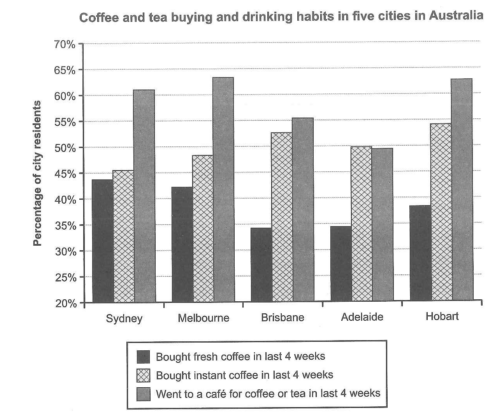
The chart below shows the results of a survey about people’s coffee and tea buying and drinking habits in five Australian cities.
Summarize the information by selecting and reporting the main features, and make comparisons where relevant.
Student answer (Band 4.5)
This chat show about people of different Australian cities to buy tea and coffee .
Mostly 64% people or different cities of Astralia to went to a cafe for tea and coffee for last 4 week .
In Hobart people bought 54% instant coffee in last 4 week .
Sadney people bought fresh coffee in last 4 week 44%.
Brisban and Adelaid bought lowest percenage to bougt fresh coffee only 33 % people bought frsh coffe in ladt 4 week .
Differebt people webt to bought a coffee and tea in kast four week but in the last 4 week different cities bought different coffee and tea some bought instant coffre in ladt 4 week and some bought fresh coffee in last 4 week .
The lowest percentage of fresh cofee .
People went to bought a coffee mostly insatant coffee .
Mlebourne city people went to cafe fir coffee they bought high percentage to went to bought a coffee
AI examiner evaluation
| Criterion | Band |
|---|---|
| Task Achievement / Task Response | 4.5 |
| Coherence and Cohesion | 3.5 |
| Lexical Resource | 4.5 |
| Grammatical Range and Accuracy | 4.5 |
| Overall | 4.5 |
Task Achievement / Task Response: Band 4.5
You identify relevant features, including café visits, instant coffee in Hobart, and fresh coffee in Sydney, and you note that Brisbane and Adelaide had the lowest fresh-coffee figures. However, the response gives only a limited and sometimes unclear account of the chart. The claim that “64%” of people across the cities went to cafés is not a meaningful overall summary: café figures vary from about 49.5% in Adelaide to around 63.5% in Melbourne. Some comparisons are also inaccurate or incomplete; for example, Melbourne, not Hobart, had the highest café figure, while Hobart had the highest instant-coffee figure. A clearer overview of the main patterns, supported by accurate comparisons across the cities, would strengthen the report.
Coherence and Cohesion: Band 3.5
There is some attempt to present separate observations, such as the figures for Hobart, Sydney, and the two cities with the lowest fresh-coffee results. However, ideas are not arranged in a clear progression, and several sentences repeat the same general point about people buying different kinds of coffee. The opening does not establish a clear overview, while the final comments about café visits and instant coffee are difficult to connect to the earlier details. Linking words and references are also limited, so the reader has to infer how the points relate. Organise the response into a brief overview followed by grouped comparisons, and use clear links such as “whereas” and “by contrast” to show differences.
Lexical Resource: Band 4.5
The response uses basic vocabulary relevant to the chart, including “fresh coffee,” “instant coffee,” “cafe,” and “percentage.” This allows the reader to recognise the general topic and some of the categories being compared. However, the range is repetitive, and several word choices or forms make the meaning difficult to follow, as in “went to bought a coffee” and “bought lowest percenage.” Spelling errors such as “Astralia,” “Sadney,” and “cofee” also reduce clarity. Use accurate chart-reporting phrases such as “the proportion of residents who visited a café” and “recorded the lowest figure,” and check spelling of city names and key terms.
Grammatical Range and Accuracy: Band 4.5
You attempt to communicate several comparisons using simple sentences, but grammatical control is inconsistent and errors sometimes obscure the intended meaning. For example, “people of different Australian cities to buy tea and coffee” lacks a complete, correctly formed clause, and “people went to bought” combines verb forms incorrectly. Articles and prepositions are also often missing or misplaced, as in “went to a cafe for tea and coffee for last 4 week.” Most sentences follow a similar basic pattern, with little accurate variation in structure. Practise forming complete subject–verb clauses and use past-tense reporting consistently, for example, “Residents in Hobart bought the highest proportion of instant coffee.”
See this exact question answered at other band scores. The same prompt compared across bands.
Browse more IELTS Writing model answers or get your own writing scored by the same AI examiner.