Band 5.5 IELTS Writing Task 1 Model Answer
Overall Band Score: 5.5 · Cambridge IELTS 15 · 2026-11-21
IELTS Writing Task 1 question
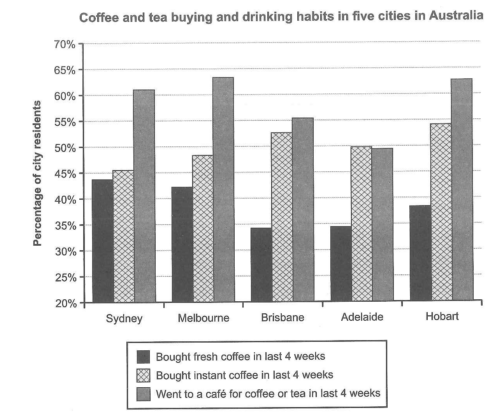
The chart below shows the results of a survey about people’s coffee and tea buying and drinking habits in five Australian cities.
Summarize the information by selecting and reporting the main features, and make comparisons where relevant.
Student answer (Band 5.5)
The bar chart compares the proportion of buying tea and coffee and their drinking habits in five Australian cities Sydney, Melbourne, Brisbane, Adelaide, Hobart in last four week.
Over all, visiting to a cafe was so popular trend among most of the people in Melbourne and Hobart. Whereas, buying fresh coffee was the least common among people in Brisbane and Adelaide. Which is the lowest value in that chart.
Comparing the figures further, round about 63% of the people of Sydney, Melborne, and Hobart had visited the cafe in the last four weeks. On the other hand, 34% people of Brisbane and Adelaide had bought fresh coffee in last four weeks which is the lowest value in all five cities.
Furthermore, in Adelaide half of th people bought instant coffee and the other half bought fresh coffee which makes the figure 50%. in Sydney it was also the same, about 45% of people had bought instant coffee and fresh coffee.
AI examiner evaluation
| Criterion | Band |
|---|---|
| Task Achievement / Task Response | 5.5 |
| Coherence and Cohesion | 5.5 |
| Lexical Resource | 5.5 |
| Grammatical Range and Accuracy | 5.5 |
| Overall | 5.5 |
Task Achievement / Task Response: Band 5.5
You identify relevant features, including café visits as a popular activity and fresh coffee as relatively uncommon in Brisbane and Adelaide. However, some key comparisons are inaccurate or unclear: café attendance was also high in Sydney, at about 61%, while the claim that roughly 63% of residents in Sydney, Melbourne and Hobart visited cafés overlooks Sydney’s lower figure. The final comparison also confuses the categories: Adelaide’s fresh-coffee figure was about 34.5%, not half, and Sydney’s fresh and instant coffee figures were not the same. The overview is therefore only partly reliable, and several figures are reported imprecisely. To strengthen the response, give a clear overview of the main patterns and check each comparison against the correct city and activity.
Coherence and Cohesion: Band 5.5
The response has a basic paragraph structure: an introduction, an overview, and two paragraphs of comparisons. This gives the reader some sense of organisation, and linking phrases such as “On the other hand” and “Furthermore” show an attempt to connect points. However, progression is limited because the comparisons are not grouped consistently by activity, and the final paragraph shifts between Adelaide and Sydney without clearly explaining the contrast. “Whereas” begins a fragment after the overview, while “Which is the lowest value” does not connect clearly to the preceding idea. Use one paragraph to compare café visits and another to compare fresh and instant coffee, with accurate linking and clear references.
Lexical Resource: Band 5.5
You use some task-relevant vocabulary, including “proportion,” “popular,” “least common,” and “bought instant coffee,” so the topic is generally understandable. However, the range is limited and several word combinations are unnatural or imprecise, such as “proportion of buying tea and coffee,” “visiting to a cafe,” and “popular trend among most of the people.” There are also spelling errors in “Melborne” and “th people,” and “cafe” should be written consistently as “café” or “cafe.” Aim for precise chart language and natural collocations, for example, “the percentage of residents who bought” and “visited a café.” This would make the comparisons clearer and more fluent.
Grammatical Range and Accuracy: Band 5.5
The response includes simple statements and some attempts to combine ideas, but control is uneven. For example, “Whereas, buying fresh coffee…” is not a complete sentence, and “Which is the lowest value in that chart” is also a fragment. The opening sentence lacks a clear grammatical structure, while “in last four week” and “34% people” show problems with articles, plurals and sentence patterns. Capitalisation after full stops is inconsistent, as in “in Sydney.” These errors sometimes make relationships between ideas difficult to follow. Practise writing complete sentences with a clear subject and verb, and check articles, plural forms and punctuation. A wider range of accurately controlled complex sentences would improve the response.
See this exact question answered at other band scores. The same prompt compared across bands.
Browse more IELTS Writing model answers or get your own writing scored by the same AI examiner.