Band 4.5 IELTS Writing Task 1 Model Answer
Overall Band Score: 4.5 · Cambridge IELTS 15 · 2026-11-21
IELTS Writing Task 1 question
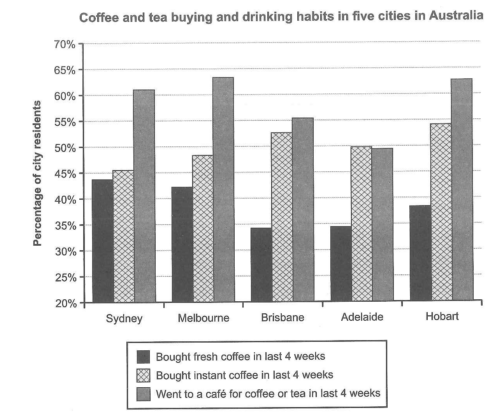
The chart below shows the results of a survey about people’s coffee and tea buying and drinking habits in five Australian cities.
Summarize the information by selecting and reporting the main features, and make comparisons where relevant.
Student answer (Band 4.5)
The bar chart illustrates the buying and consumption of coffee and tea in five Australian cities. The survey shows that majority of the people like to go out to a coffee or tea cafe in last 4 weeks in all of the five australian cities.While people who buy fresh coffee in the same period are alot smaller in number. The amount of people buying fresh coffee is a lot less in comparision to ones who goes to cafe for drinking cofe or tea in the last 4 weeks.People like to go out for walk and also enjoy coffee or tea there. In all of the five cities more than 45% of the people prepares to buy instant coffee rather going to a cafe and ordering it. People often likes it as they want to waste time sitting in coffee shops. We concluded that people love to go out for coffee or tea rather than buying at the instant. They want to enjoy time with there loved ones talking and drinking tea. It depends on people as some people like to spent there time alone while other enjoys a company.
AI examiner evaluation
| Criterion | Band |
|---|---|
| Task Achievement / Task Response | 4.5 |
| Coherence and Cohesion | 4.0 |
| Lexical Resource | 5.0 |
| Grammatical Range and Accuracy | 5.0 |
| Overall | 4.5 |
Task Achievement / Task Response: Band 4.5
The response identifies the chart’s general subject and attempts to compare café visits with fresh-coffee purchases, but it reports very few of the chart’s key features accurately. The claim that most residents in all five cities went to a café is incorrect: Adelaide is just under 50%, and café visits are not the leading activity there. The statement that more than 45% in every city preferred instant coffee to going to a café also misreads the data; café attendance is higher in Sydney, Melbourne, Brisbane and Hobart. An overview should instead highlight that café visits lead in four cities, while instant coffee is highest in Adelaide, and fresh coffee is generally the least popular. Explanations about people enjoying walks or avoiding wasted time are not shown by the chart.
Coherence and Cohesion: Band 4.0
There is some basic sequencing: the response introduces the chart, discusses café visits and fresh coffee, then turns to instant coffee and ends with a conclusion. However, the ideas are not arranged into clear, purposeful paragraphs, and the progression is weakened by repetition. For example, the comparison between fresh coffee and café visits is made twice in similar terms, while the final comments about spending time with loved ones do not develop a chart-based comparison. Linking words such as “While,” “In all,” and “We concluded” are attempted, but some connections are unclear or lead to unsupported claims. Group the information into an introduction, a concise overview, and comparisons of the city data; use references such as “this figure” only when their meaning is clear.
Lexical Resource: Band 5.0
The vocabulary is sufficient to communicate the broad topic, with relevant terms such as “bar chart,” “survey,” “fresh coffee,” “instant coffee,” and “cafe.” However, the range is limited and several word choices or collocations are inaccurate or informal for describing data. Phrases such as “a lot smaller in number,” “like to go out for walk,” and “waste time sitting in coffee shops” are imprecise, and “prepares to buy” does not express a survey preference naturally. Spelling errors, including “comparision,” “cofe,” and “there” for “their,” also reduce accuracy. Use concise reporting language such as “the proportion,” “accounted for,” and “was higher than,” and choose verbs that describe what the chart measures rather than inventing motives.
Grammatical Range and Accuracy: Band 5.0
The response attempts some longer sentence forms, including “While people who buy fresh coffee…” and “as they want to…,” but control is inconsistent and the range remains limited. Agreement errors occur in “majority of the people like” and “People often likes,” while “ones who goes” combines an incorrect pronoun with a singular verb. There are also problems with articles and sentence boundaries, as in “in last 4 weeks” and the run-together transition after “cities.” The final sentence, “some people like to spent there time alone while other enjoys a company,” contains errors in verb form, pronoun, and agreement. Practise accurate simple comparisons first, then add subordinate clauses while checking subject–verb agreement, articles, and punctuation.
See this exact question answered at other band scores. The same prompt compared across bands.
Browse more IELTS Writing model answers or get your own writing scored by the same AI examiner.