Band 4.5 IELTS Writing Task 1 Model Answer
Overall Band Score: 4.5 · Cambridge IELTS 15 · 2026-11-23
IELTS Writing Task 1 question
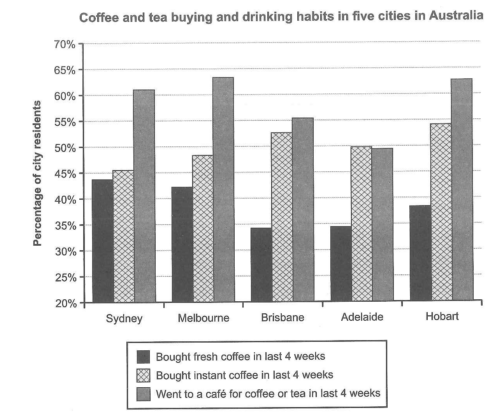
The chart below shows the results of a survey about people’s coffee and tea buying and drinking habits in five Australian cities.
Summarize the information by selecting and reporting the main features, and make comparisons where relevant.
Student answer (Band 4.5)
This bar chart compares the proportion of tendency of individuals taking coffe and tea in different urban areas of australia.
This chart represent that the ratio of individuals which visit the cafes for coffe or tea is highest as compares to instant or fresh coffee. on the other hand the proportion of fresh coffee was lowest among other options. instant coffee was mostly consumed by the citizens of Hobart city while individuals living in Sydeny have lowest rate in consumption of instant coffee which is just less then 45 percent.
on the other hand the consumption ratio of tea and coffee ate cafe is highest and the lowest is fresh and the proportion of instant coffee is bettween both of other coffee. the consumption of instant coffee is mostly viewed in
AI examiner evaluation
| Criterion | Band |
|---|---|
| Task Achievement / Task Response | 4.0 |
| Coherence and Cohesion | 3.5 |
| Lexical Resource | 5.0 |
| Grammatical Range and Accuracy | 5.0 |
| Overall | 4.5 |
Task Achievement / Task Response: Band 4.0
You identify the chart’s general subject and make relevant comparisons, including that café visits are generally more popular and that Hobart has the highest instant-coffee figure. However, the response addresses the task only minimally: it gives few accurate, specific comparisons, and the overview is repeated rather than developed. The claim that fresh coffee is the lowest option is not true across all cities, since instant coffee is lower in Sydney and Melbourne. The final sentence is unfinished, and there is no clear account of the main differences among the five cities. The response is also 19 words below the required minimum. To improve, provide a concise overview, then support it with key figures and comparisons for all three categories.
Coherence and Cohesion: Band 3.5
There is a basic attempt to organise the response: the opening introduces the chart, and phrases such as “on the other hand” signal comparison. However, ideas do not progress clearly. The point that café visits are highest and fresh coffee lowest is repeated in the second paragraph, while the final clause, “the consumption of instant coffee is mostly viewed in,” is incomplete and leaves the reader without a conclusion. The linking phrase “on the other hand” is also used where the relationship between ideas is not clearly contrasting. Use separate paragraphs for an overview and selected comparisons, and connect each figure to the city or category it describes. A complete final sentence would help the response feel finished.
Lexical Resource: Band 5.0
The response uses some task-related vocabulary, including “proportion,” “consumption,” “instant coffee,” and “fresh coffee,” so the topic is generally recognisable. However, the range is limited and several word choices or collocations are unnatural, such as “proportion of tendency,” “consumption ratio,” and “mostly viewed.” Spelling errors in “coffe,” “australia,” and “Sydeny” also reduce accuracy. Repeated use of “proportion” and “consumption” makes the description less precise, and “tea and coffee ate cafe” is difficult to interpret. Aim for standard chart language such as “percentage of residents,” “bought,” and “visited a café,” and check spelling carefully.
Grammatical Range and Accuracy: Band 5.0
You attempt some longer sentence structures, for example, “instant coffee was mostly consumed by the citizens of Hobart city while individuals living in Sydeny have lowest rate…”. However, control is inconsistent, and several sentences contain errors in agreement, articles, or sentence construction. “This chart represent” needs subject–verb agreement, while “the ratio of individuals which visit” has an unclear relative clause and tense. The opening also lacks a clear grammatical structure, and the final sentence is incomplete. Most ideas can still be understood, but these recurring problems make the response harder to follow. Practise accurate simple comparisons first, then combine them using “while” or “whereas,” checking verb forms and sentence completeness.
See this exact question answered at other band scores. The same prompt compared across bands.
Browse more IELTS Writing model answers or get your own writing scored by the same AI examiner.