Band 6.0 IELTS Writing Task 1 Model Answer
Overall Band Score: 6.0 · Cambridge IELTS 15 · 2026-11-23
IELTS Writing Task 1 question
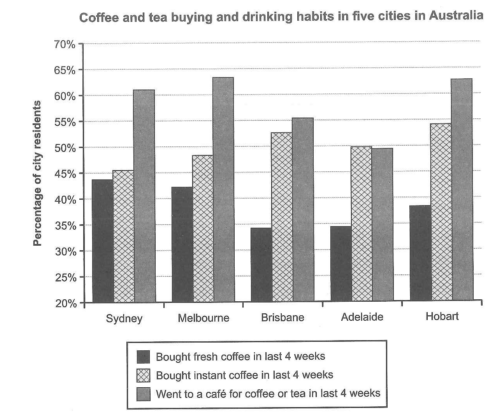
The chart below shows the results of a survey about people’s coffee and tea buying and drinking habits in five Australian cities.
Summarize the information by selecting and reporting the main features, and make comparisons where relevant.
Student answer (Band 6.0)
THE BAR CHART ILLUSTRATES THE RESULTS OF A SURVEY REGARDING ITS RESIDENTS COFFEE, AND TEA BUYING AND DRINKING HABITS IN FIVE CITIES OF THE AUSTRALIA.(SYDNEY,MELBOURNE, BRISBANE, ADELAIDE AND HOBART)
OVERALL, PEOPLE WHO BOUGHT COFFEE OR TEA ARE DISTRIBUTED IN 3 MAIN CATEGORIES WITH DIRECTLY GOING TO CAFE ON TOP IN ALL CITIES FOLLOWED BY INSTANT(COFFEE OR TEA)DRINKERS ON SECOND AND FRESH COFFEE BUYERS ON THE LAST.
PEOPLE GOING DIRECTLY TO CAFE FOR COFFEE OR TEA IN SYDNEY, MELBOURNE AND HOBART WERE ABOVE 60%.WHILE IN BRISBANE AND ADELAIDE WERE 55 AND 48 PERCENT RESPECTIVELY.
AMONG INSTANT COFFEE BUYERS HOBART WAS ON TOP WITH 54% OF ITS RESIDENTS FOLLOWED BY BRISBANE WHOSE 52% PEOPLE DRUNK INSTANT COFFEE.IN THIS CATEGORY ON NUMBER 3RD WAS ADELAIDE WITH 50% OF ITS RESIDENTS WITH MELBOURNE 47% OF ITS RESIDENTS AND ON LAST IN THIS LIST WITH 41% OF ITS RESIDENTS IS SYDNEY.
IN THE THIRD CATEGORY AMONG FRESH COFFEE BUYERS BRISBANE AND ADELAIDE HAVE SAME PERCANTAGE OF ALMOST 34%. SYDNEY AND MELBOURNE CITIZINES WERE 43 AND 42% RESPECTIVELY AND IN HOBART 37% OF RESIDENTS WERE FRESH COFFE USERS.
AI examiner evaluation
| Criterion | Band |
|---|---|
| Task Achievement / Task Response | 6.5 |
| Coherence and Cohesion | 6.5 |
| Lexical Resource | 5.5 |
| Grammatical Range and Accuracy | 5.0 |
| Overall | 6.0 |
Task Achievement / Task Response: Band 6.5
You cover all three survey categories and give a clear overview that café visits were the most common activity in every city, while fresh-coffee purchases were generally the least common. Most comparisons are supported by figures close to the chart, including Hobart’s high instant-coffee result and the similar fresh-coffee proportions in Brisbane and Adelaide. However, the overview says instant-coffee drinkers ranked second in every city, which is not true for Sydney: café visits were highest, but fresh coffee (44%) was slightly below instant coffee (45.5%), so the stated order is correct there; the main issue is that the category is described as “drinkers” rather than purchasers. Some figures are also imprecise, such as Sydney’s instant coffee at 41% rather than about 45.5%, and Melbourne’s at 47% rather than about 48.5%. More precise reporting and a sharper overview would strengthen the response.
Coherence and Cohesion: Band 6.5
The response has a recognisable progression: an introduction, an overview, and then comparisons for café visits, instant coffee and fresh coffee. This makes the main categories easy to follow, and phrases such as “followed by” and “in this category” help signal relationships. However, the overview’s ranking is not consistently supported by the later details, and the long, densely packed sentences make some comparisons harder to process. The repeated all-capital presentation and limited sentence breaks also reduce readability. Grouping the information into clearly separated paragraphs and using more precise links between the overview and supporting figures would make the progression more controlled and less mechanical.
Lexical Resource: Band 5.5
You use relevant task vocabulary, including “survey,” “residents,” “categories,” and “percentage,” so the reader can identify the subject and comparisons. However, several word choices and collocations are inaccurate or unnatural: “going directly to cafe” is not a natural way to describe visiting a café, “drunk instant coffee” is the wrong form for this meaning, and “fresh coffee users” is less precise than describing people who bought fresh coffee. Spelling errors such as “percantage,” “citizines,” and “coffe” are noticeable, while “on top” and “on last” are informal or awkward for an academic report. A broader, more accurately controlled set of reporting verbs and comparison phrases would improve clarity and precision.
Grammatical Range and Accuracy: Band 5.0
The response attempts some complex comparisons, for example, “Hobart was on top … followed by Brisbane,” and uses past-tense forms to report survey results. However, grammatical control is limited, and errors occur in many sentences. Examples include the opening phrase “regarding its residents coffee,” the incomplete construction “While in Brisbane and Adelaide were 55 and 48 percent,” and “Brisbane whose 52% people,” where sentence structure and clause formation are faulty. Articles and prepositions are also often missing or misplaced, as in “going directly to cafe.” Most sentences rely on similar basic patterns, with few accurately controlled complex structures. Practise complete comparative sentences, possessives, articles and clause linking, then check punctuation and sentence boundaries.
See this exact question answered at other band scores. The same prompt compared across bands.
Browse more IELTS Writing model answers or get your own writing scored by the same AI examiner.