Band 5.0 IELTS Writing Task 1 Model Answer
Overall Band Score: 5.0 · Cambridge IELTS 15 · 2026-11-24
IELTS Writing Task 1 question
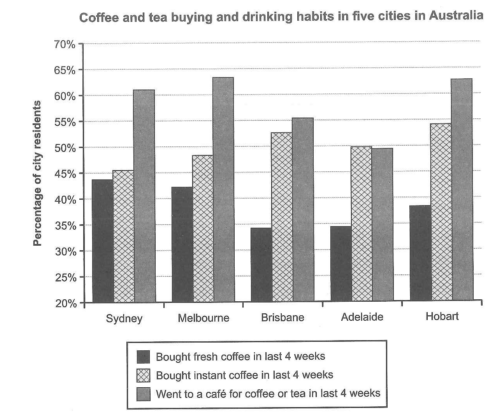
The chart below shows the results of a survey about people’s coffee and tea buying and drinking habits in five Australian cities.
Summarize the information by selecting and reporting the main features, and make comparisons where relevant.
Student answer (Band 5.0)
T he bar graph actually shows the result of a survey fo peoples coffe and tea buying drinking habits in five Australian cities.
In Sydney, The people who brought fresh coffe in last four weak is acutally 44% and the people who bought theinstant coffe in last four weeks is 46% adn also the people who went to cafe wether for coffe or tea in last 4 weeks is 62%.
In Melboume, the people who bought fresh instant coffe in last 4 weeks is 44% and the people who bought instant coffe in last 4 weeks is 48% also the people who goes to cafe for tea or coffe are 63%.
In Brisbane,the numble of people who bought fresh coffe is 34% and the instant coffe buyers is 53% also the number of people who went to cafe for tea or coffe is 56%.
In Adelaide and Hobart the percentage is given as 34% fresh coffe buyers,50% instant coffe buyers and the people who went to cafe are 49%,while in Hobart things are Different beacuse the percentage of fresh coffe buyers is 38%,the instant coffe buyers is 54% which is relatively large from all of them and the people who went to cafe is 62%.
AI examiner evaluation
| Criterion | Band |
|---|---|
| Task Achievement / Task Response | 4.5 |
| Coherence and Cohesion | 4.5 |
| Lexical Resource | 5.0 |
| Grammatical Range and Accuracy | 5.0 |
| Overall | 5.0 |
Task Achievement / Task Response: Band 4.5
You report figures for all five cities and cover all three survey categories, so the response is relevant and includes several accurate details, such as Brisbane’s instant-coffee figure and Melbourne’s café figure. However, the account is largely a city-by-city list rather than a summary of the main features. There is no clear overview identifying, for example, that café visits were generally the most popular activity and fresh-coffee purchases the least popular. Some figures are also inaccurate: Melbourne’s fresh-coffee figure is about 42.5%, not 44%, and Sydney’s café figure is about 61%, not 62%. The Adelaide sentence is confusing because it combines the city’s figures with Hobart’s. Select key comparisons and state them accurately to make the main trends clear.
Coherence and Cohesion: Band 4.5
The response has a basic sequence, moving from Sydney through Melbourne and Brisbane to Adelaide and Hobart, and repeated city openings help readers locate the information. However, it lacks a clear overall progression: there is no introductory overview, and the repeated pattern of listing three figures for each city makes the report feel like a catalogue rather than a comparison. Linking is mostly limited to “also,” while the long Adelaide-and-Hobart sentence joins several separate points and makes the relationship between them difficult to follow. Use separate paragraphs for an overview and grouped comparisons, and connect related figures with clearer contrasts such as “whereas” or “by comparison.” This would make the organisation easier to follow.
Lexical Resource: Band 5.0
You use enough task-related vocabulary to communicate the categories and figures, including “fresh coffee buyers,” “instant coffee buyers,” and “percentage.” However, the range is limited and several choices are inaccurate or awkward, which sometimes makes the meaning harder to follow. For example, “brought fresh coffee” is not the intended meaning of purchasing it, and “relatively large from all of them” is an unnatural way to describe a comparison. Spelling errors such as “coffe,” “Melboume,” and “numble” are also noticeable. Aim for precise reporting language and check spelling carefully; phrases such as “the proportion who purchased” and “the highest figure among the five cities” would be more suitable.
Grammatical Range and Accuracy: Band 5.0
Most of the response uses simple sentence patterns, often joining several pieces of information with “and.” There are attempts at longer sentences, but control is uneven: the sentence beginning “In Adelaide and Hobart” becomes difficult to parse as it shifts from Adelaide’s figures to Hobart’s without a clear sentence boundary. There are also errors in verb forms and agreement, such as “the people who goes to cafe,” and article use is inconsistent in phrases like “went to cafe.” Capitalisation and punctuation are also unreliable, including “The” after a comma and missing spaces after commas. Use shorter, complete sentences and check subject–verb agreement, articles, and sentence boundaries.
See this exact question answered at other band scores. The same prompt compared across bands.
Browse more IELTS Writing model answers or get your own writing scored by the same AI examiner.