Band 5.0 IELTS Writing Task 1 Model Answer
Overall Band Score: 5.0 · Cambridge IELTS 15 · 2026-11-24
IELTS Writing Task 1 question
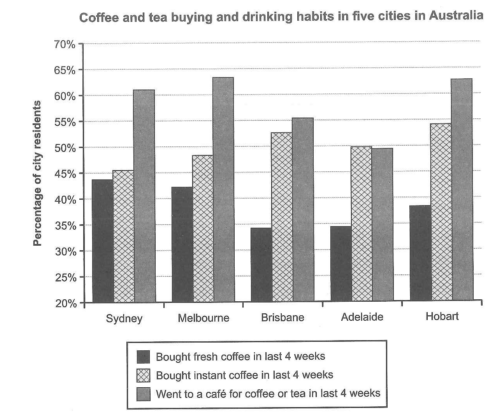
The chart below shows the results of a survey about people’s coffee and tea buying and drinking habits in five Australian cities.
Summarize the information by selecting and reporting the main features, and make comparisons where relevant.
Student answer (Band 5.0)
The graph chart illustrates the findings of a study about the Australians' habits of buying and drinking (coffee and tea) in Sydney, Melbourne, Brisbane, Adelaide and Hobart.
Overall, the number of people going to a cafe for coffee/tea in last month is the highest compared to those who bought fresh or instant coffee in most of the cities whereas the number of individuals buying fresh coffee was the lowest in every cities.
In Melbourne nearly 65% people went to cafes to drink either coffee or tea last month, which was the highest of all cities. For Hobart, the number was almost 63%, whereas for Sydney it is almost 43% and for Adelaide and Brisbane the numbers are the same (nearly 35%
AI examiner evaluation
| Criterion | Band |
|---|---|
| Task Achievement / Task Response | 4.0 |
| Coherence and Cohesion | 5.5 |
| Lexical Resource | 5.5 |
| Grammatical Range and Accuracy | 5.5 |
| Overall | 5.0 |
Task Achievement / Task Response: Band 4.0
The response identifies the chart’s subject and gives an overview that café visits were generally more common than buying either type of coffee. However, it does not adequately summarise the full data: the account stops partway through the city comparisons and gives no figures or comparisons for instant coffee, despite this being a major series. Some details are also inaccurate: Melbourne’s café figure is about 63.5%, not nearly 65% as the highest, since Hobart is about 63% and Melbourne is only marginally higher; Sydney’s café figure is about 61%, not 43% (around 43% is its fresh-coffee figure). The response is also 29 words below the required minimum. Include all three categories, select key highs and lows, and check that each figure is matched to the correct activity.
Coherence and Cohesion: Band 5.5
There is a basic, recognisable structure: an introduction, an overview, and a paragraph beginning to compare individual cities. The overview gives the reader a useful general direction, and phrases such as “whereas” and “For Hobart” attempt to connect comparisons. However, the response ends abruptly during the city-by-city account, so the information does not progress to a complete summary. The overview’s comparison is also difficult to follow because “in most of the cities” is not supported with a clear qualification. Develop a complete paragraph grouping the cities or categories logically, and use clear links to show contrasts without repeating the same sentence pattern.
Lexical Resource: Band 5.5
The response uses a reasonable range of task-related vocabulary, including “findings,” “habits,” “individuals,” and “compared to,” so the topic is generally clear. Some choices are imprecise or unnatural for describing a chart: “graph chart” is redundant, “study” is less suitable than “survey,” and “the number of people” is not the best wording when the data are percentages. “In last month” also does not accurately reflect the chart’s four-week period. These choices, together with repeated use of “number,” limit precision. Prefer concise chart language such as “the bar chart compares,” “the proportion of residents,” and “in the previous four weeks,” and vary terms carefully while preserving the exact meaning.
Grammatical Range and Accuracy: Band 5.5
The response attempts both simple and more extended sentence forms, including the overview sentence with “whereas” and the comparison beginning “For Hobart.” Meaning is usually recoverable, but several grammatical errors remain. For example, “the Australians’ habits” uses an awkward possessive construction, “in last month” is missing an article, and “the lowest in every cities” has a number-agreement error. The sentence about Melbourne also needs an article before “65% of people,” while “for Sydney it is” shifts tense from the surrounding past-time description. The final sentence is incomplete and lacks closing punctuation. Check articles, singular/plural agreement, consistent past tense, and sentence completion when revising.
See this exact question answered at other band scores. The same prompt compared across bands.
Browse more IELTS Writing model answers or get your own writing scored by the same AI examiner.