Band 5.5 IELTS Writing Task 1 Model Answer
Overall Band Score: 5.5 · Cambridge IELTS 15 · 2026-11-26
IELTS Writing Task 1 question
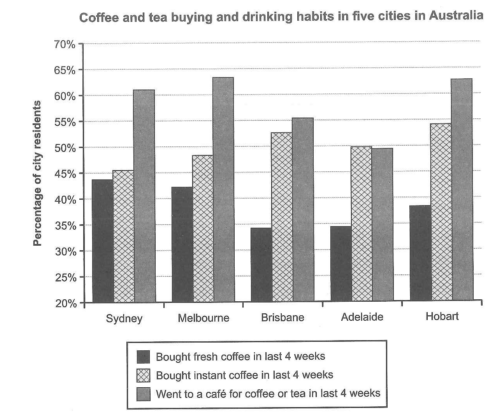
The chart below shows the results of a survey about people’s coffee and tea buying and drinking habits in five Australian cities.
Summarize the information by selecting and reporting the main features, and make comparisons where relevant.
Student answer (Band 5.5)
The bar chart illustrate the outcomes of survey about people's drinking routines and buying to tea and coffee trend in five different Australian cities. Overall, buying tea or coffee from the cafe have the highest ranking nearly in every city and bought a fresh coffee attract the least amount of customers.
Like for Sydney and Melbourne, almost 61-64% of the total residents went a cafe for coffee or tea. While around 41-44% residents bought instant coffee and around 42-44% residents brought fresh ones. On the other hand, Instant coffee and coffee from cafe almost have same percentage of residents almost around 52-55% for Brisbane and almost 50% for Adelaide city. While both cities sahe the almost same amount of residents in the case of buying fresh coffee which is 35%.
For Hobart, almost 62% went a cafe for coffee, around 55% bought instant coffee while 38% bought fresh coffee. Melboume, Sydney and Hobart have the highest number of residents that went to a cafe for coffee or tea.
AI examiner evaluation
| Criterion | Band |
|---|---|
| Task Achievement / Task Response | 6.0 |
| Coherence and Cohesion | 5.5 |
| Lexical Resource | 5.5 |
| Grammatical Range and Accuracy | 5.5 |
| Overall | 5.5 |
Task Achievement / Task Response: Band 6.0
You identify the main pattern that café visits are highest in most cities and fresh-coffee purchases are generally lowest, and you include comparisons across all five cities. Several figures are broadly accurate, including the café rates for Sydney and Melbourne and the fresh-coffee figure for Hobart. However, the overview is not fully precise: fresh coffee is not the least popular category in Adelaide, where café visits (about 49.5%) are slightly lower than instant-coffee purchases (50%). The Brisbane comparison also says café and instant coffee are almost the same, although café visits are higher (about 55.5% versus 53%). Your account covers the relevant features, but some comparisons need clearer, more accurate development.
Coherence and Cohesion: Band 5.5
The response has a recognisable structure: an introduction and overview are followed by comparisons for Sydney and Melbourne, then Brisbane and Adelaide, and finally Hobart. This gives the reader a workable route through the data. However, progression is sometimes weakened by sentence fragments beginning “While,” and by abrupt transitions such as “For Hobart” and the final return to Melbourne, Sydney and Hobart. Repeated use of “almost” and “around” also makes the comparisons feel loosely connected rather than carefully organised. Grouping cities by shared patterns and using complete linking sentences would make the progression clearer and cohesion less mechanical.
Lexical Resource: Band 5.5
You use relevant task vocabulary, including “residents,” “percentage,” “bought fresh coffee,” and “went to a cafe,” so the data is generally understandable. There is some variety in how you describe the figures, but several word choices and collocations are inaccurate or awkward: “buying to tea and coffee trend,” “highest ranking,” “attract the least amount of customers,” and “brought fresh ones.” “Sahe” and “Melboume” are spelling errors, while “cafe” should be written consistently as “café” or “cafe.” These issues make the description less precise and natural. Aim for standard chart language such as “the proportion of residents,” “recorded the highest figure,” and “purchased fresh coffee.”
Grammatical Range and Accuracy: Band 5.5
You attempt both simple and more complex sentences, and the overall meaning is usually recoverable. However, some errors in sentence structure and grammar remain. The opening needs subject–verb agreement and an article: “The bar chart illustrates the results of a survey.” In “buying tea or coffee from the cafe have,” the subject and verb do not agree; “has” is needed. Several clauses beginning “While” are incomplete, including “While around 41–44% residents bought instant coffee…” and “While both cities…”. Articles and prepositions are also missing in phrases such as “went a cafe.” Use complete sentences and check agreement, articles, and clause boundaries; this would make your comparisons easier to follow.
See this exact question answered at other band scores. The same prompt compared across bands.
Browse more IELTS Writing model answers or get your own writing scored by the same AI examiner.