Band 4.5 IELTS Writing Task 1 Model Answer
Overall Band Score: 4.5 · Cambridge IELTS 15 · 2026-11-26
IELTS Writing Task 1 question
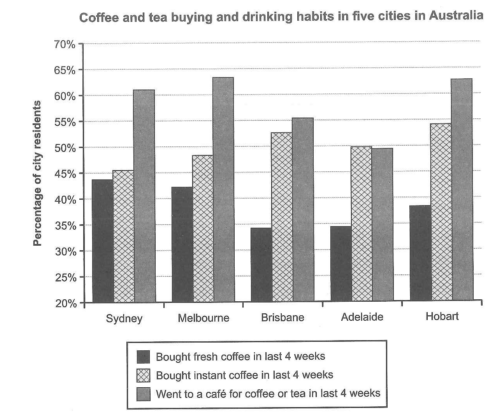
The chart below shows the results of a survey about people’s coffee and tea buying and drinking habits in five Australian cities.
Summarize the information by selecting and reporting the main features, and make comparisons where relevant.
Student answer (Band 4.5)
The pie chart illustrates coffee and tea buying drinking habits in five cities in Australia Sydney, Melbourne, brisbane. and Adelaide and Hobart.
Overall, the percentage in all cities show melbourne throughout the priod, while Adelaid and Brisbane come the lowest in the priod.
in last bought fresh coffee in Sydney, Melbourne, Brisbane and Adelaide and Hobart show decline in the number of buying under 45%, while bought instant coffeee in last 4 weeks in all the cities with highest number of buying in Hobart at 59% followed by Brisbane at 53%, while went to a coffee for coffee or tea last 4 weeks in all the cities show increased in buying at 64%, in contrast, Brisbane at 55%.
the number of buying all cities showed highest number throughout the priod .
AI examiner evaluation
| Criterion | Band |
|---|---|
| Task Achievement / Task Response | 4.0 |
| Coherence and Cohesion | 4.0 |
| Lexical Resource | 5.0 |
| Grammatical Range and Accuracy | 4.5 |
| Overall | 4.5 |
Task Achievement / Task Response: Band 4.0
You identify the chart’s general subject and mention all three activities, but the response reports the data inaccurately and does not provide a clear, reliable overview. For example, you say Melbourne is highest “throughout the period,” although café visits are highest in Melbourne and Hobart, while instant coffee is highest in Hobart and fresh coffee in Sydney. The claim that fresh-coffee figures “show decline” is unsupported because the chart gives one survey period, not a trend over time. Several figures are also wrong: Hobart’s instant-coffee result is about 54.5%, not 59%. The response is also 19 words below the required minimum. To improve, describe the main comparisons accurately, avoid implying change over time, and include enough relevant detail to summarise the chart.
Coherence and Cohesion: Band 4.0
There is a basic attempt to organise the response: an opening sentence is followed by an overview and then details about the three activities. However, the ideas are not arranged coherently enough for the reader to follow the comparisons. The long third sentence combines fresh coffee, instant coffee and café visits, with unclear links such as “while” and “in contrast”; the final sentence repeats the vague claim that all cities showed the “highest number.” Some city names and activity details are also difficult to connect to the figures being discussed. Use separate, focused paragraphs for the overview and key comparisons, and group related data clearly. Linking words should show accurate contrasts rather than joining several unrelated claims in one sentence.
Lexical Resource: Band 5.0
Your vocabulary is sufficient to identify the chart’s topic and categories, using phrases such as “fresh coffee,” “instant coffee” and “in all the cities.” However, the range is limited and several word choices or collocations make the report unclear, including “buying drinking habits,” “went to a coffee,” and “the number of buying.” Repetition of “number,” “buying” and “highest” also reduces precision. Some spelling and capitalisation errors, such as “coffeee,” “melbourne” and “Adelaid,” are noticeable. Use standard chart language such as “the proportion of residents,” “purchased,” and “visited a café,” and choose precise terms for comparisons. This would make the information easier to understand without changing the basic meaning.
Grammatical Range and Accuracy: Band 4.5
The response attempts connected sentences, but grammatical control is weak and errors frequently make relationships between ideas difficult to interpret. For example, “the percentage in all cities show melbourne throughout the priod” has problems with agreement and sentence construction, while “in last bought fresh coffee in Sydney…” lacks a clear grammatical frame. The long sentence beginning “in last bought fresh coffee” also joins several clauses without clear punctuation, and the final sentence does not form a clear comparison. Sentence structures are mostly limited, with little accurate control of complex forms. Build shorter sentences around a clear subject and verb, check singular–plural agreement and articles, and use punctuation to separate each activity and comparison.
See this exact question answered at other band scores. The same prompt compared across bands.
Browse more IELTS Writing model answers or get your own writing scored by the same AI examiner.