Band 5.0 IELTS Writing Task 1 Model Answer
Overall Band Score: 5.0 · Cambridge IELTS 15 · 2026-11-27
IELTS Writing Task 1 question
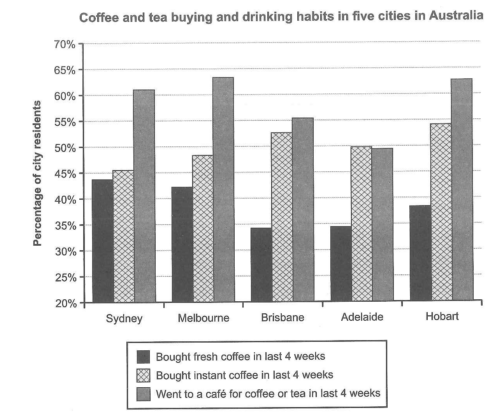
The chart below shows the results of a survey about people’s coffee and tea buying and drinking habits in five Australian cities.
Summarize the information by selecting and reporting the main features, and make comparisons where relevant.
Student answer (Band 5.0)
the chart demonstrates us the consequences of a survey about individuals coffee and tea buying and drinking habits in some Australian cities.
firstly, the persons who bought fresh coffee in last four weeks are approximately the same in sydeny as Melbourne its around 45% , while in Brisbane and Adelaide it hit a low around 35% , whereas it slightly increased in Hobart almost 40%.
secondly, people who bought instant coffee in last four weekends in Sydney was slightly lower than Melbourne its close to 45%-50% , while in Brisbane and Adelaide its the same as 35% then it increased by 5% in Hobart to reach 40% .
finally, people who went to a café for coffee or tea were the biggest bars in the chart, as we can see in Sydney and Melbourne were between 65% to 70% at its peak, and it slowly down in Adelaide to 50% before it climbed to 60% in Hobart.
so the people who went to a café are much higher than the others
AI examiner evaluation
| Criterion | Band |
|---|---|
| Task Achievement / Task Response | 5.0 |
| Coherence and Cohesion | 5.5 |
| Lexical Resource | 5.0 |
| Grammatical Range and Accuracy | 5.0 |
| Overall | 5.0 |
Task Achievement / Task Response: Band 5.0
You identify all three survey categories and give a broad overview that café visits were the most common, which is a relevant main feature. However, several comparisons are inaccurate: instant-coffee figures in Brisbane, Adelaide and Hobart are reported as about 35%, 35% and 40%, whereas the chart shows roughly 53%, 50% and 55%. Café attendance in Sydney and Melbourne is also overstated at 65–70%; the figures are about 61% and 64%. The fresh-coffee comparisons are closer, though the overview could more clearly highlight that instant coffee leads in Brisbane, Adelaide and Hobart, while café visits lead in Sydney and Melbourne. More accurate figures and a fuller comparison of the categories would make the summary more complete and reliable.
Coherence and Cohesion: Band 5.5
The response has a recognisable sequence: it discusses fresh coffee, instant coffee and café visits in turn, then ends with a general comparison. Connectors such as “firstly,” “secondly” and “finally” help signal this order. However, the organisation is somewhat mechanical, and the final sentence repeats the point that café visits are higher without adding detail. Some comparisons are difficult to follow because several cities and figures are packed into long sentences, and references such as “it” are not always clear. Grouping the cities by similar patterns and using clearer links between comparisons would create a more coherent progression and make the key features easier to understand.
Lexical Resource: Band 5.0
You use relevant task vocabulary, including “bought fresh coffee,” “instant coffee,” “went to a café” and “increased,” so the reader can generally understand the categories being described. However, the range is limited and some word choices or collocations are noticeably inaccurate, such as “the consequences of a survey” and “the biggest bars.” “Last four weekends” also changes the chart’s time period, which is given as the last four weeks. Spelling errors such as “sydeny” further reduce accuracy. Aim for precise chart language and vary expressions for proportions and comparisons; this would make the description more natural and reduce the effort required to interpret it.
Grammatical Range and Accuracy: Band 5.0
You attempt to combine comparisons using clauses with “while” and “whereas,” and the overall meaning is usually recoverable. However, the range of sentence structures is limited, and errors occur frequently in sentence formation, agreement and punctuation. For example, “the persons who bought … are approximately the same … its around 45%” contains an unclear construction and an incorrect pronoun form; “people … in Sydney was” also has subject–verb disagreement. Several sentences run together without clear punctuation, particularly the final café comparison. Practise building shorter, complete sentences first, then combine them accurately, checking verb agreement, pronoun reference and sentence boundaries.
See this exact question answered at other band scores. The same prompt compared across bands.
Browse more IELTS Writing model answers or get your own writing scored by the same AI examiner.