Band 5.0 IELTS Writing Task 1 Model Answer
Overall Band Score: 5.0 · Cambridge IELTS 15 · 2026-11-10
IELTS Writing Task 1 question
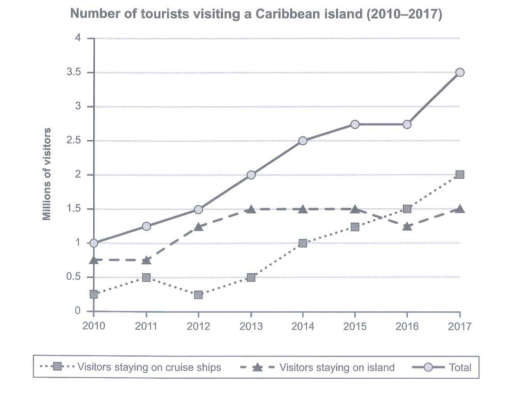
The graph below shows the number of tourists visiting a particular Caribbean island between 2010 and 2017.
Summarize the information by selecting and reporting the main features and make comparisons where relevant.
Student answer (Band 5.0)
The graph shows us the number of visitors visting a particular caribben island between 2010 and 2017. in the line grah we consider that two parts of people stays on two different place , first one is cruise ships and second one is island. In below we discuss about it.
In 2010, shows most of the tourists stayed on the island and less people stays on the ships. But in 2017 we can look in the graph and say that most of population who visited island was stayed on the cruise and lack of perople stops on the island. as the graph shows that in the year of 2017 total number of toursits stayed on the both cross the 3 million of visitors.and it was also considrable that the most of the total always go on the high rank not one year it turns on lower .
at last, it would show that visitors alwys visited onu both side and stayed on that.
AI examiner evaluation
| Criterion | Band |
|---|---|
| Task Achievement / Task Response | 5.0 |
| Coherence and Cohesion | 5.0 |
| Lexical Resource | 4.5 |
| Grammatical Range and Accuracy | 5.0 |
| Overall | 5.0 |
Task Achievement / Task Response: Band 5.0
You identify the two visitor groups and make a relevant comparison between 2010 and 2017, noting that island stays were more common at the start while cruise-ship visitors were more numerous by the end. However, the response only partially reports the graph: it gives almost no intermediate figures or trends, and the overview that totals “always go on the high rank” is vague. The 2017 comparison is also inaccurate: cruise-ship visitors reached about 2 million, compared with 1.5 million staying on the island, but this does not mean most visitors stayed on cruise ships across the whole period. To improve, summarise the overall rise in total visitors and the contrasting trends in the two categories, supporting these points with selected figures.
Coherence and Cohesion: Band 5.0
There is a basic attempt to organise the response into an introduction, a main paragraph and a brief ending, and the reader can identify the two visitor categories being discussed. However, the progression is not clear: the final sentence repeats the general idea that visitors used both options rather than adding a useful summary. Linking phrases such as “But,” “as the graph shows,” and “at last” are used mechanically or do not clearly connect the ideas. Some references are also difficult to follow, particularly “most of population who visited island” and “the most of the total.” Organise the report around an overview followed by key comparisons, and use clear references and transitions to show how each point relates to the data.
Lexical Resource: Band 4.5
The response uses a small set of relevant terms, including “visitors,” “tourists,” “cruise ships,” and “island,” so the topic is generally recognisable. However, vocabulary is limited and several spelling errors—such as “visting,” “caribben,” “grah,” and “toursits”—make the writing less clear and less controlled. Some phrases are also unnatural or imprecise, including “most of population,” “cross the 3 million,” and “high rank.” Aim for accurate, task-specific language to describe quantities and trends, such as “rose to,” “remained stable,” and “accounted for.” Proofreading spelling and choosing natural collocations would make the report easier to understand.
Grammatical Range and Accuracy: Band 5.0
You attempt to combine ideas using clauses, for example, “But in 2017 we can look in the graph and say that…,” but the range of sentence structures is limited and these longer attempts are often faulty. Errors in verb forms and sentence construction occur throughout: “In 2010, shows” lacks a clear subject, “people stays” does not agree, and “was stayed” uses an incorrect passive form. Articles and prepositions are also often missing or misplaced, as in “on two different place” and “visited island.” Capitalisation and punctuation are inconsistent, including the lowercase “in” after the opening sentence. Practise accurate simple sentences first, then build longer comparisons with controlled clauses and consistent past-tense reporting.
See this exact question answered at other band scores. The same prompt compared across bands.
Browse more IELTS Writing model answers or get your own writing scored by the same AI examiner.