Band 5.5 IELTS Writing Task 1 Model Answer
Overall Band Score: 5.5 · Cambridge IELTS 15 · 2026-11-10
IELTS Writing Task 1 question
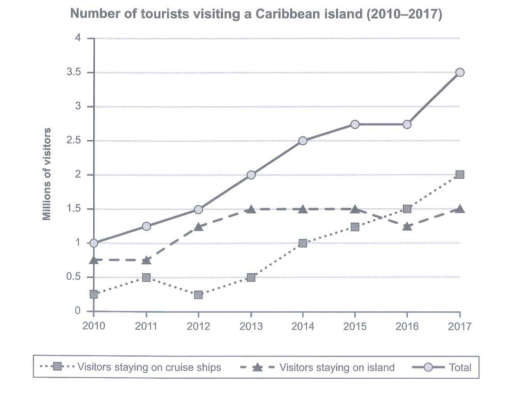
The graph below shows the number of tourists visiting a particular Caribbean island between 2010 and 2017.
Summarize the information by selecting and reporting the main features and make comparisons where relevant.
Student answer (Band 5.5)
The vertical graph below illustrates that, how many visitors are visiting a particular Caribbean island from year 2010 to 2017.
Overall, this chart shows that, the visitors who decided to stay on the cruise ship has the highest ratio in 2017 about 3.5 million of visitors, on the contrary the ratio of visitors in 2010, and 2012 was the lowest about less thaan half a million people.The people who were staying on island have the highest ratio from 2013 to 2015 approximately one and a half million; meanwhile, the total number of visitors were highest in number during during 2017 nearly 3.5 million, and lowest in 2010 about 1 million.
The number of visitors staying on the cruise were less than 0.5 million in 2010 and 2012, were 0.5 million in 2011, about 0.5, 1, 1.25, 1.5, and 2 million from 2014 to 2017 respectively. visitors staying on island were more than 0.5 million in 2010, and 2011, more than 1 million in 2012, 1.5 million in 2013 to 2015, more than 1 million in 2016, and were 1 millon in 2017. The total number of visitors were about 1 million in 2010, more than one in 2011, were 1.5, 2,and 2.5 in 2012, 2013, and 2014 respectively, it was about 2.6 million in 2015 and 2016, the highest ratio was in 2017 about 3.5 million.
AI examiner evaluation
| Criterion | Band |
|---|---|
| Task Achievement / Task Response | 5.5 |
| Coherence and Cohesion | 5.5 |
| Lexical Resource | 5.0 |
| Grammatical Range and Accuracy | 5.0 |
| Overall | 5.5 |
Task Achievement / Task Response: Band 5.5
You identify the overall rise in total visitors and include figures for all three series, so the response is relevant and gives the reader a broad account of the graph. However, some key comparisons are unclear or inaccurate. In particular, 3.5 million in 2017 is the total, not the number staying on cruise ships; that figure is 2 million. The claim that cruise-ship visitors were highest in 2017 is true, but the overview confuses this with the total. You also report island visitors as 1 million in 2017, whereas the chart shows about 1.5 million. Select the main trends accurately, distinguish the series, and avoid describing the lowest figures as “less than half a million” when the island-staying group was higher.
Coherence and Cohesion: Band 5.5
The response has a recognisable structure: an introduction, an overview, and a paragraph giving figures. This helps separate general trends from details. However, progression is weakened by repetition: the 2017 total and the 2010 total are mentioned in both the overview and the final paragraph, and the final paragraph largely lists values rather than grouping related trends. Linking phrases such as “on the contrary” and “meanwhile” are used, but the contrast they signal is not always clear. Organise the details by series or by periods of change, and use comparisons to connect the figures—for example, noting that island visitors remained around 1.5 million while cruise-ship numbers rose sharply after 2013.
Lexical Resource: Band 5.0
You use some task-relevant vocabulary, including “visitors,” “total number,” “approximately,” and “million,” and the reader can generally identify the categories being discussed. However, the range is limited and several choices are inaccurate or repetitive. “Ratio” is not suitable for a number of visitors; use “figure” or “number.” “Vertical graph” is less natural than “line graph,” and “visitors staying on the cruise” is better expressed as “visitors staying on cruise ships.” Spelling errors such as “thaan” and “millon,” along with inconsistent capitalisation at the start of sentences, reduce control. Aim for precise terms for trends and comparisons, such as “rose steadily,” “remained stable,” and “peaked.”
Grammatical Range and Accuracy: Band 5.0
You attempt longer sentences with clauses linked by “while,” “meanwhile,” and “and,” but complex structures are often faulty, and errors occur frequently enough to make some sentences difficult to follow. For example, “illustrates that, how many visitors are visiting” has an unnecessary construction, while “the visitors … has” shows subject–verb disagreement. The overview also contains a run-on sequence of clauses, with repeated “during” and unclear punctuation. Tense and sentence patterns are inconsistent, as in “were 1.5, 2,and 2.5” and “visitors staying on island were.” Practise writing shorter, complete sentences with consistent past-tense reporting, correct agreement, and clear punctuation before combining ideas into longer comparisons.
See this exact question answered at other band scores. The same prompt compared across bands.
Browse more IELTS Writing model answers or get your own writing scored by the same AI examiner.